Math Mammoth Grade 5 complete curriculum
Math Mammoth Grade 5 Complete Curriculum is a complete math program for 5th grade, providing you with everything you need to teach 5th grade math. It is available both as a download version and as printed copies.
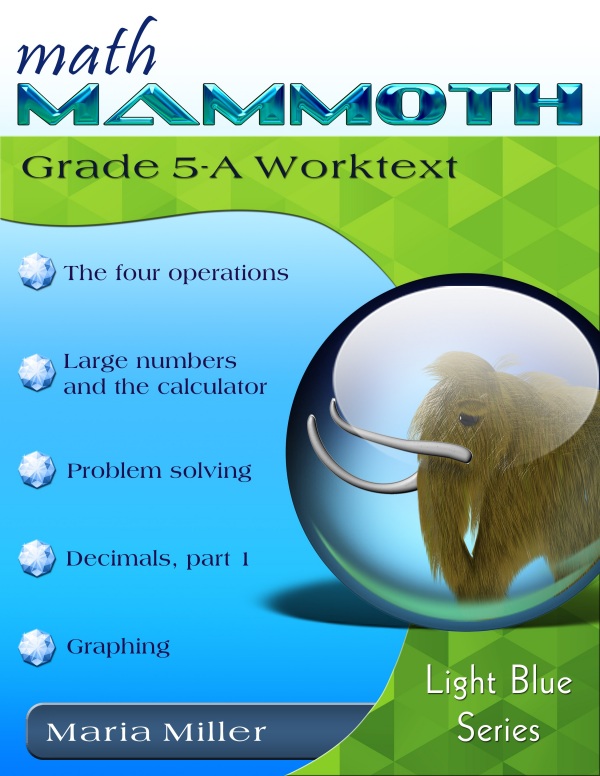
200 pages
176 lesson pages
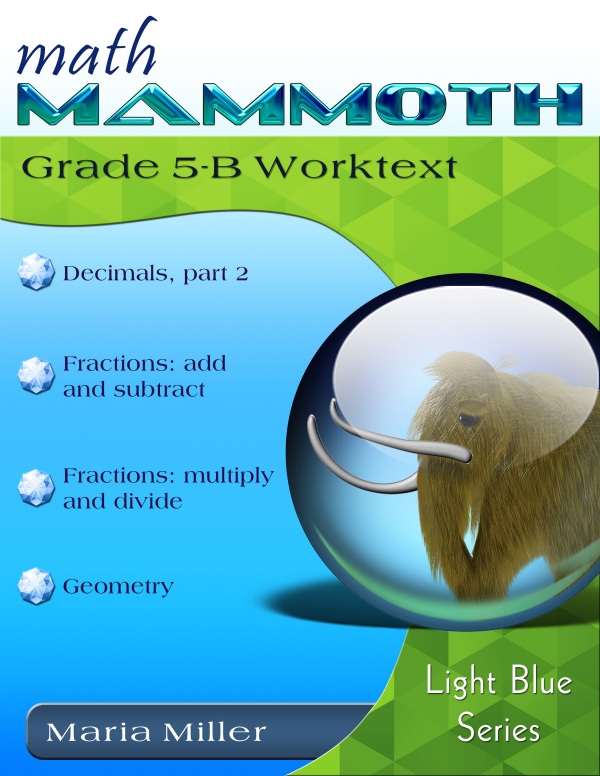
219 pages
182 lesson pages
5-A contents and samples
5-B contents and samples
Worksheet generator preview
User Guide, grade 5
CCS Alignment / Contents
Scope & sequence
Errata
FAQ
Prices & ordering
You can purchase Math Mammoth Grade 5 as a digital download, or as already printed books.
Digital version
2023 edition
Grade 5 complete:
USD $42.50 (download)
(the two worktexts, answer keys, tests, cumulative reviews, a worksheet maker, Soft-Pak)
Part 5-A only:
USD $21.75 (download)
(Everything for the first half of 5th grade math; includes Soft-Pak)
Part 5-B only:
USD $21.25 (download)
(Everything for the second half of 5th grade math; includes Soft-Pak)
2020 edition
Click the link to add the product to cart.
You will be purchasing the downloads from my authorized reseller Comecero.
Lesson plan
The lesson plan assigns specific pages from the curriculum to each day in the plan, plus includes links to the teaching videos, and to online games, activities, and illustrations.
Regular version — $9.95 USD
interactive version to be used inside Homeschool Planet planner (2023 edition).
PLUS version — $14.95 USD
includes both the interactive and a PDF version (2023 edition).
Printed copies
Rainbow Resource Center sells perfect-bound texts either with full color or with grayscale interior pages.
2023 editions:
Grade 5 (grayscale)
Grade 5 (color)
2020 editions:
Grade 5 (grayscale)
Grade 5 (color)
At Lulu you will find spiral/coil bound student books and the tests & reviews book. The answer key is perfect bound.
2023 editions:
5-A worktext
5-B worktext
Tests & Cum Reviews
Answer Keys
The 2020 editions are available from Lulu, also. See this list.
Supportive materials
Includes the answer keys, tests, cumulative reviews, worksheet maker, and software Soft-Pak (digital download). Purchase this to go with printed student books. Do not purchase if you get the full digital version as listed above.
2023 edition (USD $9.60):
2020 edition (USD $9.60):
Skills Review Workbook
A supplemental workbook providing additional practice in a spiral manner for the topics in the curriculum. I recommend you only purchase it once you are sure the student does need supplemental practice. Learn more.
At the heart of the curriculum are two student worktexts (A and B), each covering about half a year of math work. These worktexts contain all the instruction and the exercises in the same book — which makes lesson preparation a breeze. The worktexts are written directly to the student, and thus they allow many students to teach themselves and to learn directly from the books.
You will also get separate answer keys, chapter tests, additional cumulative reviews (I do recommend you use at least some of them), and a versatile worksheet maker (Internet access required) for those times when your child needs just a bit more practice.
Features
- Math Mammoth focuses on conceptual understanding. It explains the "WHY", so your children can understand the math, not just learn "HOW" to do it.
- Concepts are often explained with visual models, followed by exercises using those models. These visual models can take the place of manipulatives for many children; however, it is very easy to add corresponding manipulatives to the lessons if so desired.
- The curriculum is mastery-oriented. This means it concentrates fairly long on a topic, delving into its various aspects. This promotes conceptual understanding, as opposed to spiral curricula that often tend to jump from topic to topic too much.
- There is a strong emphasis on mental math and number sense.
- Very little teacher preparation is required.

- The curriculum has no separate teacher's manual nor is it scripted. The introduction to each chapter has some notes for the teacher concerning the material in the chapter. All the instruction is written directly to the student in the worktext, and there also exist accompanying videos where you can see Maria herself teach the material.
- After each chapter introduction, you will find a list of Internet links and resources (games, quizzes, animations, etc.) that can be used for fun, illustrations, and further practice.
Additional features for the digital (download) version
- The PDF files can be filled in on a computer, phone, or tablet, using the annotation tools found in many PDF apps. Learn more.
- BONUS! The download version also comes with BONUS Soft-Pak programs. The 6 programs in Soft-Pak (4 math, 1 language arts, 1 list maker) offer both on-screen and printable activities in a low-graphic, high content format. Read more and see screenshots.

Overview of topics
The main areas of study in Math Mammoth Grade 5 are:
- the four operations with whole numbers
- place value with large numbers and the judicious use of calculator
- problem solving & simple equations
- decimal arithmetic (all operations with decimals)
- graphing
- fraction arithmetic (all operations with fractions)
- geometry: review of angles, area, and perimeter; drawing circles; classifying triangles & quadrilaterals; volume of rectangular prisms
Please also see the table of contents 5-A and 5-B (in the sample files), which will let you see the topics covered in more detail.
Read about the changes between the 2020 and 2023 editions.
Supplements
Lesson plan
We offer a lesson plan for Math Mammoth Grade 5, sold in two different versions.
- The lesson plan assigns specific pages from the curriculum to each day in the plan, thus pacing the curriculum for you.
- The plan also includes links to the teaching videos by the author.
- Lastly (and this is a great feature!), the plan includes online games, activities, and illustrative tools, all mapped to the individual lessons in the curriculum.
The plan comes in two versions: regular and PLUS.
Regular version
This is an interactive version of the plan be used inside Homeschool Planet planner — $9.95 USD. Learn more.
PLUS version
The PLUS version includes both the interactive version and a PDF file of the plan — $14.95 USD. Learn more.
Skills Review Workbook
Math Mammoth Skills Review Workbook, Grade 5 provides additional practice for the topics in Math Mammoth Grade 5 curriculum. I recommend you only purchase it once you are sure your student does need supplemental practice. Learn more.
Introduction
The fifth grade is time for fractions and decimals, in particular. We study fractions and decimals and the operations with them in depth and with substantial detail. Students also deepen their understanding of whole numbers, learn much more problem solving, learn geometry and graphing, and get introduced to the calculator.
The year starts out with a study of whole numbers and their operations. Students review multi-digit multiplication and learn long division with two-digit divisors. We also review divisibility and factors from fourth grade, and study prime factorization.
In the second chapter, the focus is on large numbers and using a calculator. This is the first time a calculator is introduced in Math Mammoth curriculum — thus far, all calculations have been done mentally, or with paper and pencil. I want students to learn to be critical in their use of the calculator and use it with good judgment. Every exercise where calculator use is to be allowed is marked with a little calculator symbol.
The third chapter is about equations and problem solving. We study simple equations with the help of a pan balance. Students also do a fair amount of problem solving using the visual bar model.
The fourth chapter is about decimals and some of the operations with decimals (the rest will be studied in chapter 6). Fifth grade is the time when students learn all the basic operations with decimals. In this chapter, we focus on place value with decimals, addition and subtraction of decimals, and multiplication and division of decimals by whole numbers. Multiplying decimals by decimals and dividing decimals by decimals is covered in chapter 6.
In chapter 5, students graph points and patterns in the coordinate grid, and learn about line graphs and average (mean). These topics tie in both with graphing in the context of algebra, and with statistical graphs.
Chapter 6 continues our study of decimals. The focus is on multiplying decimals by decimals, dividing decimals by decimals, and conversions between measuring units.
Chapter 7 covers the addition and subtraction of fractions — another focus topic of 5th grade besides decimals. The most difficult topic of this chapter is adding and subtracting unlike fractions, which is done by first converting them to equivalent fractions with a common denominator.
In chapter 8, we study the multiplication and division of fractions from various angles.
Chapter 9 takes us to geometry, starting with a review of angles and polygons. Then, students learn to classify triangles and quadrilaterals, and study the concept of volume in the context of right rectangular prisms (boxes).
Manipulatives
Here is a list of manipulatives that are needed or recommended for grade 5.
- A ruler that measures in inches (for 5-B).
- A ruler that measures in centimeters (for 5-B).
- A compass and protractor (for 5-B).
- Fraction manipulatives. The curriculum contains printables to make your own fraction manipulatives. The text uses visual pie models extensively, and students even learn to draw them themselves for the exercises, therefore making or buying the manipulatives is entirely optional (optional; for 5-B).
Reviews & testimonials
Math Mammoth review at As They Grow Up blog
I’d like to express my appreciation for your Math Mammoth curriculum. We’re coming from another curriculum, but have used Math Mammoth in the past. Unfortunately, the previous curriculum was spiraled, which made it difficult for my 5th grader to remember how to work the problems when they resurfaced. I basically had to re-teach the problems at every encounter. Also, it was difficult to apply the learned concepts to new problems. There were frequent reviews, so I thought the spiral method would be okay, but the review work seemed to bog my homeschooler down. We switched partway through the year and haven’t looked back. I believe our initial year of Math Mammoth really carried us through the other curriculum and I’m sorry we moved away from Math Mammoth. We’ll be Mathies through 8th grade :-)
Thank you for making it available and so affordable and for allowing us to purchase just what we need at the time.
God bless and take care, India M.
Heather M.
MaryLu C
- Karrie W., Co-op Member
Jennifer
Note: the two reviews below refer to the older version of MM5. However, it is fundamentally similar to the new, revised version.
Math Mammoth is AWESOME!
Bonnie
January 2012
My youngest daughter has had a difficult Grade 5 year with math and had some extra learning assistance provided at school. I have often worried that because all instruction is in French, her second language, it may ultimately be more difficult for her to understand the math lessons or perhaps the way it was taught. And although I have tried to help her during the school year, it became more of an exercise in translation, for I have only taken 1 year of basic Introductory French at University, and she had to translate the question for me before I could help.
I knew that we needed to work on this over the summer. I learned that there were more gaps in her math knowledge than I previously believed. This is when I abandoned tutoring her math in French, and began looking for worksheets on the internet. I was very happy to come across your free worksheets but after looking at the complete Mammoth worktext sample pages and the Youtube clips to help teach the 'teacher', I was so impressed, I bought the Grade 5 Light Blue worktext A and B. I really like how clearly the lessons are explained and how the concepts flow together seamlessly and that you personalized this course with instruction for the 'teachers'. And when I told my daughter that I found a math teacher on the internet that can teach ME how to teach, she seemed pleased and perhaps a little relieved (!!? )
So here we are, day 4, page 17, she is picking up speed and her attitude has lifted as she begins to understand math covered so far. I really like the the lessons or rules are highlighted or outlined so it is easier to refer back to. The worksheet are visually appealling as well. I hope we can get through the whole course this summer without it being too arduous, but I see that she is gaining self esteem and excitement she works though questions with a little less guidance from me.
So, Thankyou very much Maria!
I expect to be purchasing the grade 6 Light Blue worktext to 'work along' with her as she returns to Math in grade 6 French immersion in September. I feel more confident that I will be able to track her progress and then offer help as necessary (or IF necessary!).
Sincerely, Elaine
July 2010
How and where to order
You can buy Math Mammoth books at:
- Here at MathMammoth.com website — simply use the "Add to cart" buttons you see on the product pages.
- Rainbow Resource carries printed copies for the Light Blue series books.
- Homeschool Buyers Club offers download versions of the Light Blue series, plus the Blue series bundle.
- Homeschool Planet sells the digital versions of the main curriculum and lesson plans to go with them.
- K5 Learning offers download versions of the Blue series.
- TPT sells the Light Blue Series downloads, plus topical units.
- Lulu sells printed copies for most of the Math Mammoth materials (various series).
By purchasing any of the books, permission IS granted for the teacher (or parent) to reproduce this material to be used with his/her students in a teaching situation; not for commercial resale. However, you are not permitted to share the material with another teacher.
In other words, you are permitted to make copies for the students/children you are teaching, but not for other teachers' usage.
Math Mammoth books are PDF files. I recommend you use Adobe Reader to view them, including if you use a Mac. You can try other PDF viewers, but they may at times either omit or mess up some of the images.
Receive my monthly collection of math tips & resources directly in your inbox — and get a FREE Math Mammoth book!

You can unsubscribe at any time.
Math Mammoth TourConfused about the different options? Take a virtual email tour around Math Mammoth! You'll receive: An initial email to download your GIFT of over 400 free worksheets and sample pages from my books. Six other "TOURSTOP" emails that explain the important things and commonly asked questions concerning Math Mammoth curriculum. (Find out the differences between all these different-colored series!)This way, you'll have time to digest the information over one or two weeks, plus an opportunity to ask me personally about the curriculum. A monthly collection of math teaching tips & Math Mammoth updates (unsubscribe any time) We respect your email privacy.
Note: You will FIRST get an email that asks you to confirm your email address. If you cannot find this confirmation email, please check your SPAM/JUNK folder. |
"Mini" Math Teaching CourseThis is a little "virtual" 2-week course, where you will receive emails on important topics on teaching math, including:
- How to help a student who is behind You will also receive: A GIFT of over 400 free worksheets and sample pages from my books right in the very beginning.
A monthly collection of math teaching tips & Math Mammoth updates (unsubscribe any time)
We respect your email privacy.
Note: You will FIRST get an email that asks you to confirm your email address. If you cannot find this confirmation email, please check your SPAM/JUNK folder. |
Maria's Math TipsEnter your email to receive math teaching tips, resources, Math Mammoth news & sales, humor, and more! I tend to send out these tips about once monthly, near the beginning of the month, but occasionally you may hear from me twice per month (and sometimes less often). Peek at the previous tips here. You will also receive:
We respect your email privacy.
|
|