
Hello again! |
1. Math Mammoth news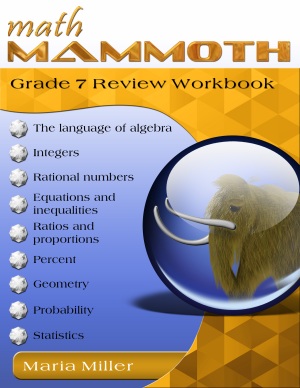 Both editions of the review workbook are available. If you have purchased the Grade 7 Review Workbook in the past (digital version), and would like this newer edition, contact us to request the update. The next sale for MM digital products is just around the corner! Stay tuned! |
2. Tears and strugglesFrom time to time I hear from a parent that says that they're doing Math Mammoth and their child is in tears and struggling a lot.This is a red flag, and usually means that they've been placed to too high a level. The math is beyond their current understanding. I realize tears could also result from some other reasons, such as vision problems, dyslexia, etc. But it's more common that it's from the child lacking some "piece"(s) in their mathematical understanding. Ideally, we want our students to work "on the edge" of their current understanding. This means that the new material they're studing is "stretching" their brain a little, but not too much. With a little bit of struggle, the new things are accessible to them. When their math work is like this, they have great joy from the AHA moments they achieve as they work on problems. And they learn! Their brain grows, as they struggle to a degree (but not too much). If the work is too easy, there is no learning. If it's too difficult, naturally they don't learn then either. It's really about finding the balance! If this has happened to you, my suggestion is that you take a step back — possibly even take a break — to some earlier level, where the child is comfortable. You might even put them far enough back where the work is easy. I just said that when things are easy, they won't learn, which is true... BUT in some situations, it is beneficial to do this, so that the child can have a period of time with NO stress about math at all. Kind of like a "healing period". This will also allow them to gain confidence, which is often greatly lacking if a child has hit that "tear" stage. The final goal is still to get to the place where the child has to struggle a little bit to learn new material. I have a suggestion for workbooks that several of my customers in this situation have enjoyed. 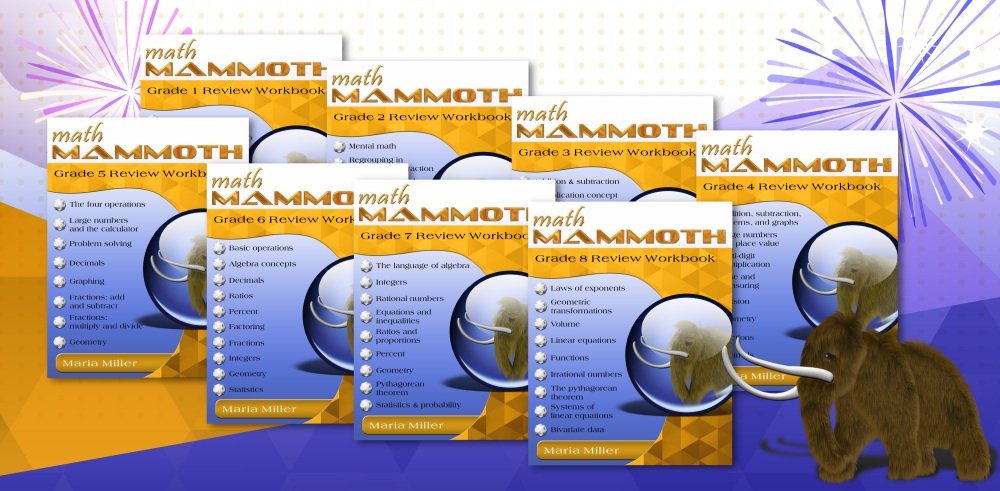 Math Mammoth review workbooks are intended to give students a thorough review of their particular grade level of math, following the main areas of math for each grade. Each book has both topical as well as mixed (spiral) review worksheets, and includes both per-topic tests and a comprehensive end-of-the-year test. The tests can also be used as review worksheets, instead of tests. For example, if a child has come from some other curriculum to Math Mammoth Grade 4, and is in tears, perhaps using the review workbook for grade 3 for a while would give them some foundations. Games are also great to utilize if your child or student has been through a lot of tears and frustration. For example, for some offline games, check out Acing Math — a collection of math card games. |
3. Cheat sheetsSomeone asked me recently if we could produce "cheat sheets" or anchor charts for a certain math topic.This is a possibility some day... but I also gave them an idea that I feel is a far better option: ask your child or students to make such a chart! That way they will learn the topic far better than if you just print out a chart for them to use. 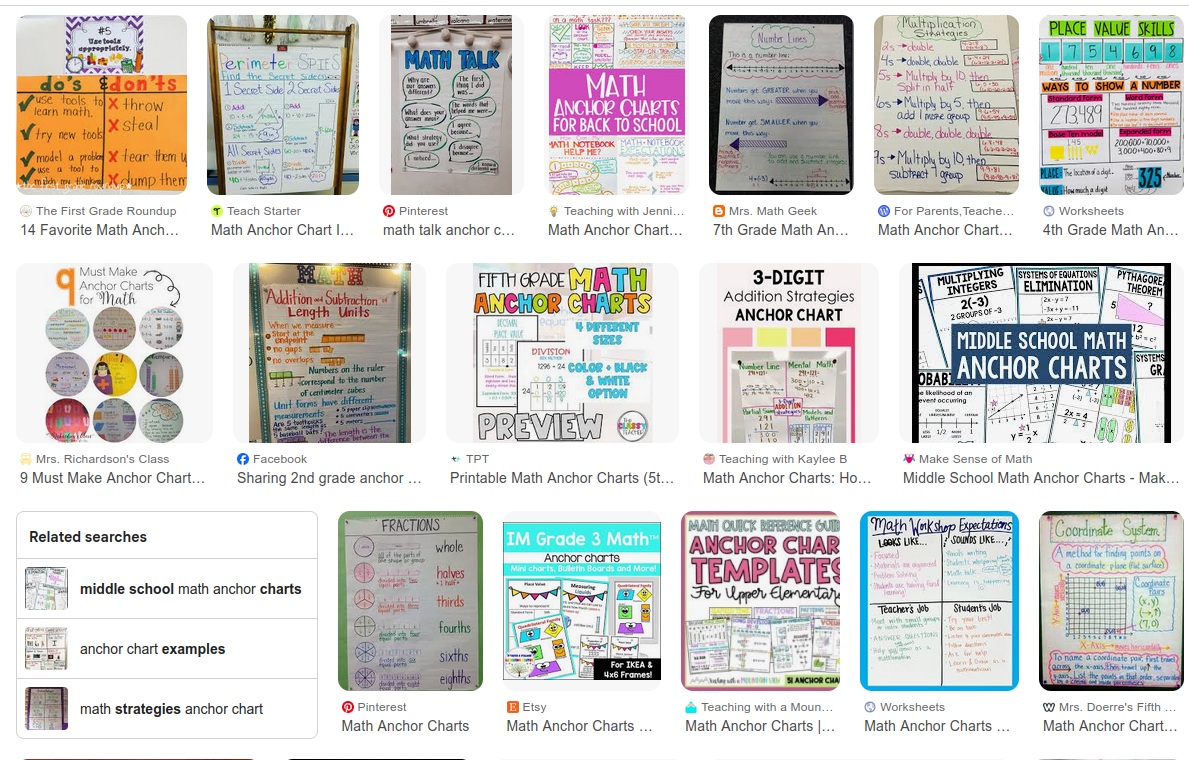 Cheat sheets can be useful for any topic where there are several bits of info to basically memorize. For example, definitions of common geometric shapes, conversion factors/charts for measurement units, the multiplication table, rules for fraction arithmetic, strategies for mental math, and so on. Making one is a great hands-on activity and allows children to be creative! |
4. The interactive multiplication courseCheck out my interactive multiplication course at TinyTap!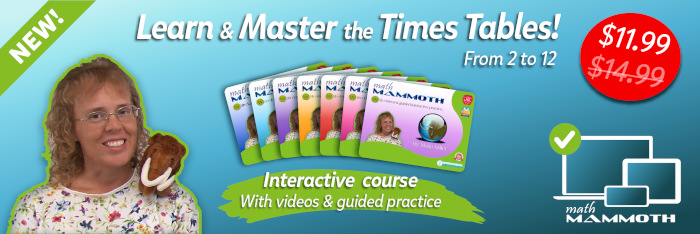 This course is based on my book Math Mammoth Multiplication 1 but is in an interactive format. For just $11.99, you will get access to 20 interactive lessons that contain videos and interactive exercises. Some lessons focus on a particular multiplication table, while others are for reinforcing earlier concepts and skills. The lessons contain not only simple practice, but also word problems, puzzles, and other types of multiplication exercises. See the course! |
5. Measurement online activityNew at Math Mammoth Practice!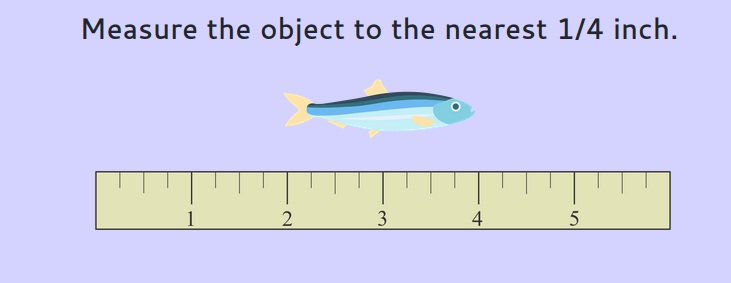 Children can now practice measuring items with a ruler with our online activity. You can choose whole inches, common fractions of an inch, centimeters, and millimeters. Granted, measuring items in real life is preferable than doing it online... but sometimes you might want to assign a task from there, plus we do have one special feature: a broken ruler: 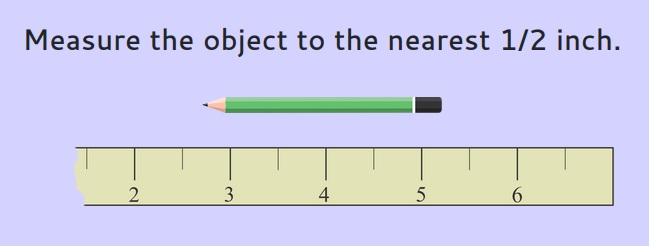 (The ruler is draggable, by the way.) Measuring items with a broken ruler requires one to understand that the measurement is the difference in the distance between two points on the ruler. You can also generate a quick link with specific options pre-selected. For example, This link includes 5 questions, with measuring objects to either 1/4 or to 1/8 of an inch. Check it out! |
6. Just for fun!
Thanks for reading! 🙂 Feel free to forward this issue to a friend/colleague! Subscribe here. Till next time, Maria Miller |
| Complete curriculum | Math games and interactive practice | Math Mammoth freebies | New to MM? Start here |
| Privacy & your personal data | Gold at the End of the Rainbow | Blue Series: For filling in gaps |