Math Mammoth Place Value 1
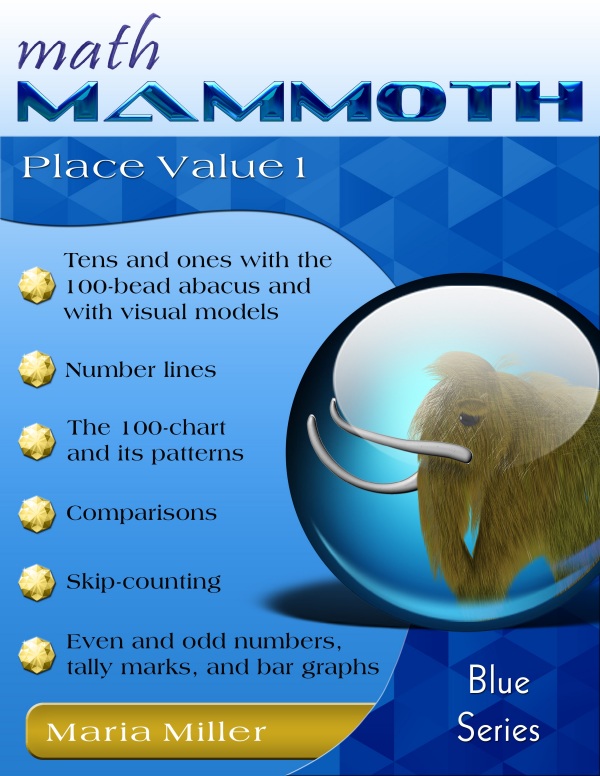
63 pages
(answers included)
Sample pages
Contents
Counting in Groups of Ten
Building Numbers 11-40
Which Number is Greater?
Skip-Counting
Prices & ordering
PDF download USD $3.90
You will be purchasing the downloads from my authorized reseller Comecero.
Printed copy $9.50 USD
 Este libro en español
Math Mammoth Place Value 1 focuses on place value and two-digit numbers and is primarily meant for first grade level math.
When children count, they basically just learn numbers as some kind of continuum that goes on without end. With simple counting, your child might not catch on to the inherent structure of the number system. Our number system is based on the idea that if you have lots and lots of objects, the efficient way to count and denote them is with groups of tens, hundreds, and thousands — not individually.
The crucial point in understanding the concept of place value is therefore that a certain position represents a certain size group. The digit in each position tells us how many groups of that size there are. For example, in the number 2,381, an adult already knows that the 8 represents eight tens, and not just "8" and that the 3 represents three hundreds, and not just "3". The place of the digit tells us the size of the group, and the digit itself tells how many of that group.
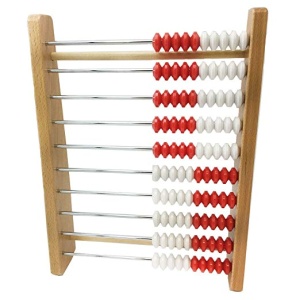
The initial lessons of the book that introduce tens and ones use a 100-bead abacus extensively. This 100-bead abacus or school abacus simply contains ten beads on ten rods, for a total of 100 beads. It is not the special abacus used by the Chinese or the Japanese. Each bead simply represents one. The 100-bead abacus lets children both "see" the numbers and use their touch while making them.
You will need to purchase this school abacus separately, such as on Amazon, or make your own. Browse Amazon's abacus selection here. An abacus or counting frame where the beads alternate colors by fives is the best but even if the beads are the same color, it will work. TIP: If you get a regular abacus with 10 beads the same color, paint a thin white line on the right side of bead #5 and also on the left side of bead #6 on each row (counting from the left). This will make it easier to see 5 and 5 on each row.
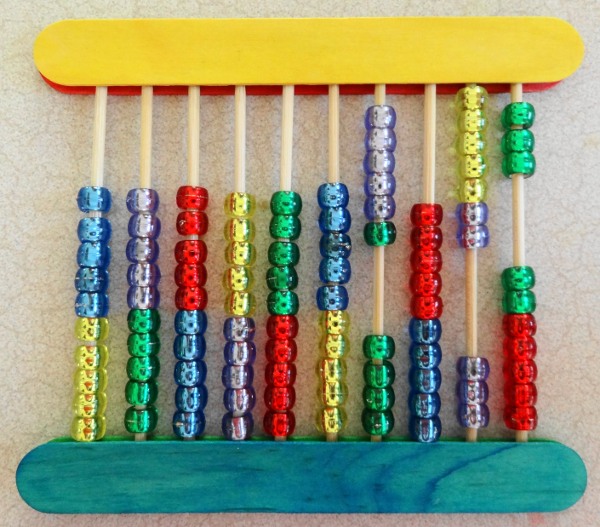
You can also use this virtual abacus (Click the + symbol to add rows of beads). Or, make your own abacus. Just don't make it exactly like they show on that web page but instead use 10 bamboo skewer with 10 beads in each so you get a 10 x 10 abacus.
Here's an image of a home-made abacus one of my customers made using bamboo skewers, craft sticks, and beads:
The abacus is used in the first lessons, but it is not the only model used in the book. We also use base-ten blocks as a visual representation of two-digit numbers. If you own a set of base-ten blocks (manipulatives), you can use them along with the visual exercises, if desired.
Moreover, we also use number lines and the 100-chart. Number lines help to visualize how numbers continue indefinitely and also relate to the concept of measuring. The 100-chart helps the child to be familiar with the numbers below 100 and find patterns in the number system.
While most of the lessons in the book focus on place value, students also practice adding and subtracting multiples of ten, and rounding numbers to the nearest ten. The two lessons near the end of the book about tally marks and graphs are real-life applications of two-digit numbers. The last lesson about regrouping can be challenging, thus is optional.
The PDF version of this book can be filled in on a computer, phone, or tablet, using the annotation tools found in many PDF apps. See more.
Check out also our free, online 100-chart skip-counting activity.
- Math Mammoth Subtraction 1—a worktext about subtraction concept, difference, fact families, addition and subtraction facts within 0-10, and word problems (grade 1).
- Math Mammoth Add & Subtract 2-A—a worktext about "easy" additions and subtractions within 0-100, memorizing the basic addition facts of single-digit numbers, and word problems (grades 1-2).
- Math Mammoth Place Value 2—a worktext about three-digit numbers (place value), comparing, ordering, rounding, bar graphs, and pictographs (grade 2).
- Free place value worksheets for grade 1 — includes building a two-digit number worksheets (such as 70 + 4 = ____ ), tens and ones missing number problems (such as 5 + ___ = 65), and 100-chart worksheets.
Better Yet - Bundle Deals!
Blue Series - $165 (download)Blue Series for grades 1-3 - $49 (download)
Blue Series for grades 4-5 - $47 (download)
Blue Series for grades 6-8 - $69 (download)
Light Blue Series, grades 1-8 - $225 (download)
Light Blue Series, grades 1-4 - $112.50 (download)
Light Blue Series, grades 5-8 - $112.50 (download)
All Inclusive Bundle - $275 (download)
"Everything" Bundle - $330 (download)
Learn more about the bundles!
*BONUS*: Buy any bundle listed above, and get the fully upgraded Soft-Pak software for FREE (includes 4 math and 2 language arts programs, complete with on screen and printable options).
How and where to order
You can buy Math Mammoth books at:
- Here at MathMammoth.com website — simply use the "Add to cart" buttons you see on the product pages.
- Rainbow Resource carries printed copies for the Light Blue series books.
- Homeschool Buyers Club offers download versions of the Light Blue series, plus the Blue series bundle.
- Homeschool Planet sells the digital versions of the main curriculum and lesson plans to go with them.
- K5 Learning offers download versions of the Blue series.
- TPT sells the Light Blue Series downloads, plus topical units.
- Lulu sells printed copies for most of the Math Mammoth materials (various series).
By purchasing any of the books, permission IS granted for the teacher (or parent) to reproduce this material to be used with his/her students in a teaching situation; not for commercial resale. However, you are not permitted to share the material with another teacher.
In other words, you are permitted to make copies for the students/children you are teaching, but not for other teachers' usage.
Math Mammoth books are PDF files. I recommend you use Adobe Reader to view them, including if you use a Mac. You can try other PDF viewers, but they may at times either omit or mess up some of the images.
Receive my monthly collection of math tips & resources directly in your inbox — and get a FREE Math Mammoth book!

You can unsubscribe at any time.
Math Mammoth TourConfused about the different options? Take a virtual email tour around Math Mammoth! You'll receive: An initial email to download your GIFT of over 400 free worksheets and sample pages from my books. Six other "TOURSTOP" emails that explain the important things and commonly asked questions concerning Math Mammoth curriculum. (Find out the differences between all these different-colored series!)This way, you'll have time to digest the information over one or two weeks, plus an opportunity to ask me personally about the curriculum. A monthly collection of math teaching tips & Math Mammoth updates (unsubscribe any time) We respect your email privacy.
Note: You will FIRST get an email that asks you to confirm your email address. If you cannot find this confirmation email, please check your SPAM/JUNK folder. |
"Mini" Math Teaching CourseThis is a little "virtual" 2-week course, where you will receive emails on important topics on teaching math, including:
- How to help a student who is behind You will also receive: A GIFT of over 400 free worksheets and sample pages from my books right in the very beginning. A monthly collection of math teaching tips & Math Mammoth updates (unsubscribe any time)
We respect your email privacy.
Note: You will FIRST get an email that asks you to confirm your email address. If you cannot find this confirmation email, please check your SPAM/JUNK folder. |
Maria's Math TipsEnter your email to receive math teaching tips, resources, Math Mammoth news & sales, humor, and more! I tend to send out these tips about once monthly, near the beginning of the month, but occasionally you may hear from me twice per month (and sometimes less often). Peek at the previous tips here. You will also receive:
We respect your email privacy.
|
|