
In this article I discuss some general principles in helping students that are behind in math.
- Test and assess
- Make a list of topics to study
- Perhaps go back to the very beginning?
- Restudying some topics while using a math curriculum
- The order of topics
- Should you go on with new concepts or not?
- A suggestion for review worktexts
How to Help a Student Who is Behind in Math?
1. Test and assess

If your student struggles, you probably already have an idea which math topics are difficult for him or her, but knowing for sure is better. By testing you can be sure to find all the weak areas. This is important because mathematics builds upon earlier concepts.
I recommend using Math Mammoth placement tests as free, generic math ASSESSMENT tests. The tests are very comprehensive and are designed to allow educators to find out exactly what areas of math the child has not mastered.
Please note you're not using the tests to necessarily find out what grade level the student is in (though you can), but to pinpoint the exact areas of math that he or she needs help with. So look at the test results closely, question by question.
You can even administer several tests from neighboring grade levels, or ask the student to complete only sections in the lower level tests. Stress to the student that the test is for evaluation purposes, not for giving grades.
2. Make a list of topics
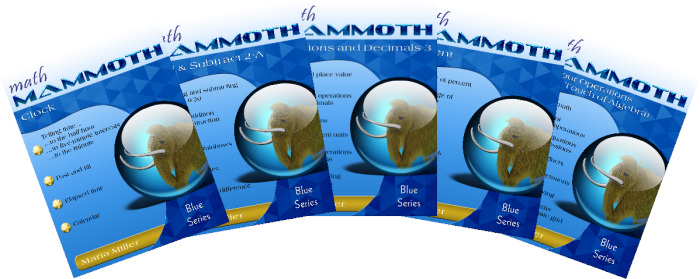
Once you know the topics where the student struggles, make a list of them. If there are only a few, then it is fairly easy to fill in the gaps: simply use Math Mammoth Blue Series books to address those areas.
The Blue Series books are worktexts, which means that they contain both the explanations (the "text") and the problems (the "work"). Each book deals with one area of math, such as place value, addition & subtraction, multiplication tables, multi-digit multiplication, long division, measuring, clock, money, geometry, fractions, decimals, proportions, percent, integers, equations, geometry, statistics, and so on. In other words, the books are topical. They cover all the math topics in grades 1-8. See a full list of the books and the topics here.
The Blue Series books are sold as downloads with very affordable prices, and they are also available as printed copies. Download lots of free samples from these links, and see for yourself!
MathMammoth_Samples_Blue_Series_grades_1-3.zip
MathMammoth_Samples_Blue_Series_grades_4-8.zip
3. Perhaps go back to the very beginning
The question is more complex if the student is seriously behind. What if your child is in 7th grade but still struggling with 3rd grade topics, such as the multiplication tables?
Here's one possibility. Some of my customers have actually gone back to the very beginning — 1st or 2nd grade math — with Math Mammoth complete curriculum, and had their child work through every grade level systematically, building a very solid foundation.
Typically, an older child can cover many grade levels of elementary math in one year. Don't ask the child to do every problem, but "skim through" the lessons, concentrating on the difficult areas. One idea is to have the child complete the chapter review before studying that particular chapter, in order to discover which lessons from the chapter the child should actually study. I feel this is a good option for many children who are seriously behind.
4. Restudying some topics while using a math curriculum
If you use a regular math curriculum, one way is study a weak area just before the same topic in the child's regular math curriculum. For example, the child could restudy basic division (a 3rd grade topic) just before tackling long division in a 4th grade book. This approach works best if the gaps are not many.
5. The order of topics
I want to point out that if you are planning to have the student review many topics, the sequence of those topics DOES matter. Certain concepts "flow together." For example, the multiplication tables are important to master before studying basic division, factoring, or most operations with fractions.
Here are some examples where you need to study one concept before another:
addition → concept of multiplication
multiplication tables → division facts → divisibility → equivalent fractions, adding unlike fractions, simplifying fractions → factors & factoring
place value → multi-digit addition, subtraction, multiplication, and long division
adding and subtracting like fractions, place value → concept of decimal numbers
decimal place value → decimal addition & subtraction
the concept of decimal numbers and of fractions → percent
the concept of fraction and of ratio → probability
Geometry, measuring, clock, money, and graphs are topics that are usually easy to incorporate into the current course of study.
This scope & sequence chart may also help you.
6. Should you go on with new concepts or not?
This is not a "yay or nay" question. With some children, it's advisable to present some new concepts while reviewing earlier ones. That can keep them motivated and not feel so behind. Obviously you cannot start a study of, say, long division if your student lags behind in the basic multiplication or division facts, but you may be able to "sprinkle in" some place value, geometry, time, money, or measuring. Geometry is an especially good area to use while reviewing old concepts, because it typically does not require many calculations.
In some cases, you may have to go back a lot and spend a significant amount of time relearning "old" topics. However, in that scenario, the "old" topics are actually "new" to the student so shouldn't feel boring to him or her. Just use your judgment.
Also, there is a benefit in presenting some actual grade-level content to the student who is behind. That is, it sets the expectation TO the grade level they're supposed to be at, and setting high expectations has been proven to improve student learning and achievement. All of us tend to strive harder when we try to meet a high expectation!
From that, one idea is to present grade-level content but along with it, teach also the prerequisites for it from earlier grades. For example, let's say the child is supposed to be learning fraction addition but they haven't yet learned equivalent fractions. You would therefore teach both topics. (This may not always work... sometimes the grade-level content is indeed too challenging, until the student first learns some earlier concepts.)
As you can see, your approach can vary. The important thing is that you first assess the student's knowledge and make some kind of "game plan" so you can feel confident in getting started. If you have to change your plan, that's alright — in fact, that is quite normal.
7. Suggestion for review worktexts
 Math Mammoth Blue Series worktexts are an excellent means of reviewing or relearning forgotten topics. [A worktext means
that the book contains both explanations (the "text") and problems (the "work) in the same book.]
Math Mammoth Blue Series worktexts are an excellent means of reviewing or relearning forgotten topics. [A worktext means
that the book contains both explanations (the "text") and problems (the "work) in the same book.]
Each Blue Series book focuses on a major math topic, explaining the concepts and providing varied practice, often with visual models.
The topics covered in the Blue Series range from 1st grade addition to 8th equations, and everything in between: place value, addition & subtraction facts, multiplication tables, multi-digit multiplication, long division, measuring, clock, money, geometry, fractions, decimals, proportions, percent, integers, statistics, equations, and more.
See a full list of topics & books here, with grade-level suggestions for each book.
These books are sold both as digital downloads (very affordable) and as printed copies.
Now some years later, our oldest daughter is studding Architectural Engineering in the best university in Greece, and our second daughter in studding Aerospace Engineering abroad in a top 10 university in the world. Also, our first son is now preparing to take university entrance exams and he is looking for an engineering subject. The series are amazing, after the first couple of months that we had to "enforce" extracurricular study to our kids, they covered the material by themselves.
Thank you very much
John Vrakas
- Christie P., Co-op Member
Because it is an important life skill, this summer we have really tried to focus on telling time and counting/understanding money. Your books are the first method that has ever worked for her. The breakdown, explanations, and practice have been just what she needed to finally be able to master these topics. Thank you for creating them and for keeping them so accessible and affordable!
Billi Jo
Tanya G, Co-op Member
Kind regards,
Gayla
I find the way Math Mammoth teaches each concept to be easily accessible. There is enough visual support for my visual learner without the use of wild or distracting graphics such as I've seen in some other programs. The balance of new teaching and review practice seems right on. Math Mammoth Blue Series has made me better able to successfully teach math to my children, and in the process improves my own mathematical thinking. I'm simply thrilled with this program.
- Carly S.
Thank you so much!
Rena
Zoe Caroll
- Peggy Dalley
Receive my monthly collection of math tips & resources directly in your inbox — and get a FREE Math Mammoth book!

You can unsubscribe at any time.
Math Mammoth TourConfused about the different options? Take a virtual email tour around Math Mammoth! You'll receive: An initial email to download your GIFT of over 400 free worksheets and sample pages from my books. Six other "TOURSTOP" emails that explain the important things and commonly asked questions concerning Math Mammoth curriculum. (Find out the differences between all these different-colored series!)This way, you'll have time to digest the information over one or two weeks, plus an opportunity to ask me personally about the curriculum. A monthly collection of math teaching tips & Math Mammoth updates (unsubscribe any time) We respect your email privacy.
Note: You will FIRST get an email that asks you to confirm your email address. If you cannot find this confirmation email, please check your SPAM/JUNK folder. |
"Mini" Math Teaching CourseThis is a little "virtual" 2-week course, where you will receive emails on important topics on teaching math, including:
- How to help a student who is behind You will also receive: A GIFT of over 400 free worksheets and sample pages from my books right in the very beginning. A monthly collection of math teaching tips & Math Mammoth updates (unsubscribe any time)
We respect your email privacy.
Note: You will FIRST get an email that asks you to confirm your email address. If you cannot find this confirmation email, please check your SPAM/JUNK folder. |
Maria's Math TipsEnter your email to receive math teaching tips, resources, Math Mammoth news & sales, humor, and more! I tend to send out these tips about once monthly, near the beginning of the month, but occasionally you may hear from me twice per month (and sometimes less often). Peek at the previous tips here. You will also receive:
We respect your email privacy.
|
|