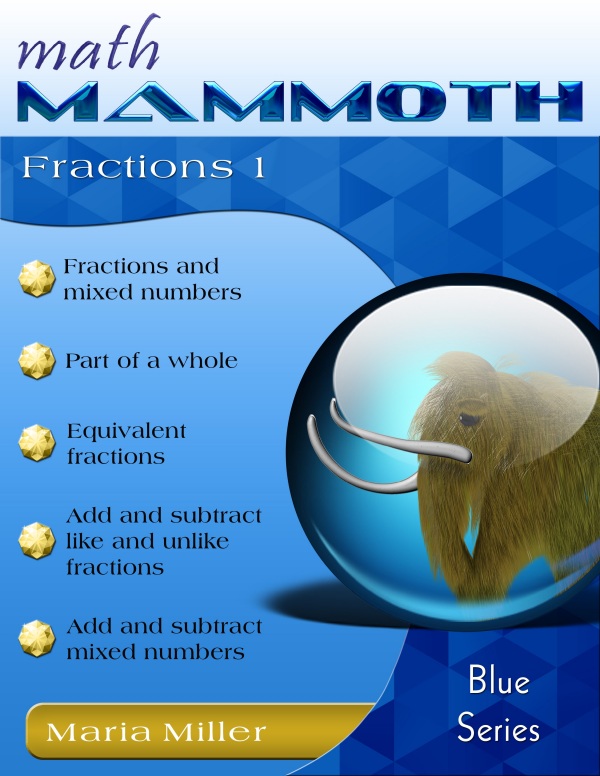
Math Mammoth Fractions 1
73 pages
(includes answers)
Contents and Introduction
Adding Mixed Numbers
Equivalent Fractions
Adding and Subtracting Unlike Fractions
Comparing Fractions
Prices & ordering
U.S. version
PDF download USD $4.60
International version
(all metric; A4 paper size)
PDF download USD $4.10
You will be purchasing the downloads from my authorized reseller Comecero.
Printed copy $10.10
Other bookstores (incl. Amazon):
Use ISBN 9781954358591.
 Este libro en español
Math Mammoth Fractions 1 is the first book of two that cover all aspects of fraction arithmetic. This book covers the concepts of fraction and mixed number, equivalent fractions, adding and subtracting like and unlike fractions, adding and subtracting mixed numbers, comparing fractions, and measuring in inches. The book Math Mammoth Fractions 2 covers the rest of fraction arithmetic: simplifying fractions and multiplication and division of fractions.
I have made a set of videos to match many of the lessons in this book. You can access them at https://www.mathmammoth.com/videos/fractions_1
Studying fractions involves lots of rules, and many students learn them only mechanically, not really understanding the underlying concepts and principles. Students then end up making lots of mistakes because they confuse the different rules, and either apply the wrong one or apply the right rule but don't remember it quite right. All this can make students even fear fractions.
To avoid that, we use the visual model of a pie divided into slices all the way through the book. It is a natural model because a circle can be divided into any number of circle sectors (slices). When students work with this model from lesson to lesson, they will eventually start seeing these pies in their mind. This, in turn, gives them the ability to do many of the easier fraction calculations mentally. It also enables students to really UNDERSTAND these concepts, and not just learn mechanical rules.
You are welcome to use manipulatives along with the book; however the visual pie model is probably sufficient for most students in the fifth grade level. I have also included (in the appendix) printable cut-outs for fractions from halves to twelfths.
The first lesson, Fraction Terminology, explains various fraction terminology such as proper and improper fractions, like and unlike fractions, and so on. The student can refer back to this information as needed.
The lesson Review: Mixed Numbers briefly goes over how to write fractions as mixed numbers and vice versa. The concepts in this lesson are prerequisites for the rest of the book.
The next lessons cover adding and subtracting mixed numbers when the fractional parts have the same denominator. The lessons are well illustrated with “pies” to help the student visualize how regrouping works in the context of fractions.
Then, it is time to study equivalent fractions, as a prerequisite for adding unlike fractions. Equivalent fractions are presented as parts that have been split further. The rule is to multiply both the numerator and the denominator by the same number, but try to emphasize the terminology of “splitting the existing parts into so-and-so many pieces” or something similar. That should help students to understand the concept instead of memorizing a mechanical rule.
Adding and Subtracting Unlike Fractions is an introductory lesson in the sense that the student is not yet introduced to the rule for finding the common denominator. Instead, in this lesson, the common denominator is either given, or the student figures it out using pictures.
Finding the (Least) Common Denominator emphasizes the idea that we need to find a common denominator, and then convert the fractions to like fractions before adding.
Next, students add and subtract mixed numbers with unlike fractional parts and solve some word problems relating to the concept.
Then we cover the concept of comparing fractions. The lesson presents several strategies, many of which have been studied in earlier grades. New for this level is to convert the fractions to equivalent, like fractions, just like when adding fractions.
In the last two lessons of the book, students learn to measure items using 16th parts of an inch and to make line plots from measurement data.
The answers are appended.
This workbook is most suitable for 5th grade. However, it is not tied to any grade level and does not mention anything about grade levels (except in the introduction), and so it can be used in various settings. It is also very good for remedial teaching or for students with learning challenges because of its heavy usage of visual models.
The PDF version of this book can be filled in on a computer, phone, or tablet, using the annotation tools found in many PDF apps. See more.
See also:
Free videos to match many of the lessons in this book.
Add and subtract fractions – online practice
Math Mammoth Fractions 2 – a sequel to this book, covering fraction simplification, multiplication, and division.
- Math Mammoth Fractions 2—a worktext about fraction multiplication and division and related topics (grades 5-6).
- Math Mammoth Fractions & Decimals 3—a worktext for all fraction and decimal topics with large denominators and more decimal digits (grades 6-7).
- Make It Real Learning: Fractions, Percents, and Decimals I—an activity workbook with real-world data, focusing on situations that use fractions, percents, and unit conversion (grades 4-7).
- Make It Real Learning: Fractions, Percents, and Decimals II—an activity workbook with real-world data, focusing on situations that use decimals, ratios, histograms, and percents (grades 5-9).
Customer reviews and testimonials
Review of Fractions 1 & 2 from Learning Legacy blog
Review of Math Mammoth Fractions books from Leaders in Learning blog
We have used Mammoth Math in the past when my child was "getting stuck" when it came to long division. And we purchased fractions from you about three weeks ago and I have to say fractions is coming easy. We tried various other curriculums for our homeschooling math and only yours has given my child both the visual, and hands on, in ways that he needed. In fact your method of teaching fractions is exactly how I learned when was in school in Australia. Thank you so much for a program that is easy to teach, easy to understand and easy to learn. My child actually enjoys math for the first time. We look forward to the next level of Mammoth math.
Frances Castelli
October 2010
Thanks so much,
Robbie
SHannon
Tia Kline
Paula Listzwan
Cyndi Kane
I emailed Maria on this. She suggested many websites that I could test my daughter. I found out that she was a year and half behind. I thank God that I found Maria Miller's website because I have purchased the fraction book to help my daughter. She now has fractions down pat. She also has the long division down as well.
Maria takes these problems down to the basics and explains in excellent detail how to solve a fraction or long division math problem. Without the tools that she has given me, I would not have been able to bring my daughter forward and current on her math skills. Maria teaches it as I was taught many many years ago. She provides the tools to help our children succeed in mathematics. I just wish that there were more websites like hers in the other subjects.
I am currently using the Geometry module for my youngest daughter. She is enjoying that module immensely. It explains it perfectly for her.
Thank Maria for having an incredibly useful website and books. I thank the heavens above for someone like you.
Sincerely,
Amy K. Burt
November 30, 2008
I plan to homeschool my daughter when she is old enough and I can't wait to use these materials with her...
thanks!!!!!
Jill Gaspard
Better Yet - Bundle Deals!
Blue Series - $180 (download)Blue Series for grades 1-3 - $59 (download)
Blue Series for grades 4-5 - $49 (download)
Blue Series for grades 6-8 - $72 (download)
Light Blue Series, grades 1-8 - $225 (download)
Light Blue Series, grades 1-4 - $112.50 (download)
Light Blue Series, grades 5-8 - $112.50 (download)
All Inclusive Bundle - $275 (download)
"Everything" Bundle - $330 (download)
Learn more about the bundles!
*BONUS*: Buy any bundle listed above, and get the fully upgraded Soft-Pak software for FREE (includes 4 math and 2 language arts programs, complete with on screen and printable options).
How and where to order
You can buy Math Mammoth books at:
- Here at MathMammoth.com website — simply use the "Add to cart" buttons you see on the product pages.
- Rainbow Resource carries printed copies for the Light Blue series books.
- Homeschool Buyers Club offers download versions of the Light Blue series, plus the Blue series bundle.
- Homeschool Planet sells the digital versions of the main curriculum and lesson plans to go with them.
- K5 Learning offers download versions of the Blue series.
- TPT sells the Light Blue Series downloads, plus topical units.
- Lulu sells printed copies for most of the Math Mammoth materials (various series).
By purchasing any of the books, permission IS granted for the teacher (or parent) to reproduce this material to be used with his/her students in a teaching situation; not for commercial resale. However, you are not permitted to share the material with another teacher.
In other words, you are permitted to make copies for the students/children you are teaching, but not for other teachers' usage.
Math Mammoth books are PDF files. I recommend you use Adobe Reader to view them, including if you use a Mac. You can try other PDF viewers, but they may at times either omit or mess up some of the images.
Receive my monthly collection of math tips & resources directly in your inbox — and get a FREE Math Mammoth book!

You can unsubscribe at any time.
Math Mammoth TourConfused about the different options? Take a virtual email tour around Math Mammoth! You'll receive: An initial email to download your GIFT of over 400 free worksheets and sample pages from my books. Six other "TOURSTOP" emails that explain the important things and commonly asked questions concerning Math Mammoth curriculum. (Find out the differences between all these different-colored series!)This way, you'll have time to digest the information over one or two weeks, plus an opportunity to ask me personally about the curriculum. A monthly collection of math teaching tips & Math Mammoth updates (unsubscribe any time) We respect your email privacy.
Note: You will FIRST get an email that asks you to confirm your email address. If you cannot find this confirmation email, please check your SPAM/JUNK folder. |
"Mini" Math Teaching CourseThis is a little "virtual" 2-week course, where you will receive emails on important topics on teaching math, including:
- How to help a student who is behind You will also receive: A GIFT of over 400 free worksheets and sample pages from my books right in the very beginning. A monthly collection of math teaching tips & Math Mammoth updates (unsubscribe any time)
We respect your email privacy.
Note: You will FIRST get an email that asks you to confirm your email address. If you cannot find this confirmation email, please check your SPAM/JUNK folder. |
Maria's Math TipsEnter your email to receive math teaching tips, resources, Math Mammoth news & sales, humor, and more! I tend to send out these tips about once monthly, near the beginning of the month, but occasionally you may hear from me twice per month (and sometimes less often). Peek at the previous tips here. You will also receive:
We respect your email privacy.
|
|