Math Mammoth Fractions 2
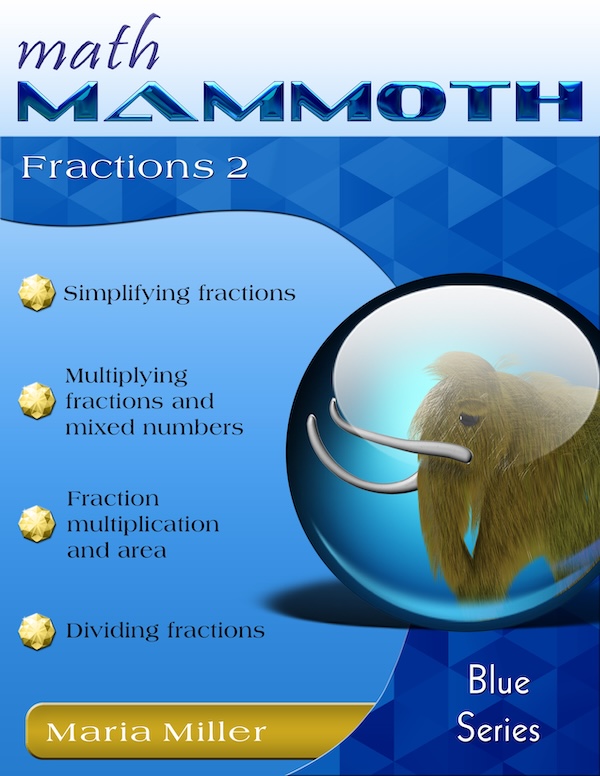
83 pages
(includes answers)
Contents
Multiplying Fractions by Whole Numbers 1
Multiplying Fractions by Fractions
Multiplication and Area
Dividing Fractions 1: Sharing Divisions
Prices & ordering
U.S. version
PDF download USD $4.90
International version
(all metric; A4 paper size)
PDF download USD $4.90
You will be purchasing the downloads from my authorized reseller Comecero.
Printed copy $10.25
Other bookstores (incl. Amazon):
Use ISBN 9781954358607.
 Este libro en español
Math Mammoth Fractions 2 continues the study of fraction topics after Math Mammoth Fractions 1. (I sincerely recommend that the student study the Fractions 1 book prior to studying this book, if he has not already done so.)
This book is meant for fifth grade, and deals in-depth with the following topics:
- simplifying; including simplifying before multiplying
- multiplication of fractions (and of mixed numbers);
- division of fractions.
We start out by simplifying fractions. Since this process is the opposite of making equivalent fractions, studied in Math Mammoth Fractions 1, it should be relatively simple for students to understand. We also use the same visual model, just backwards: This time the pie pieces are joined together instead of split apart.
Next comes multiplying a fraction by a whole number. Since this can be solved by repeated addition, it is not a difficult concept at all.
Multiplying a fraction by a fraction is first explained as taking a certain part of a fraction, in order to teach the concept. After that, students are shown the usual shortcut for the multiplication of fractions.
Then, we find the area of a rectangle with fractional side lengths, and show that the area is the same as it would be found by multiplying the side lengths. Students multiply fractional side lengths to find areas of rectangles, and represent fraction products as rectangular areas.
Simplifying before multiplying is a process that is not absolutely necessary for fifth graders. I have included it here because it prepares students for the same process in future algebra studies and because it makes fraction multiplication easier.
Students also multiply mixed numbers, and study how multiplication can be seen as resizing or scaling. This means, for example, that the multiplication (2/3) × 18 km can be thought of as finding two-thirds of 18 km.
Next, we study the division of fractions. The first lesson on the topic shows how fractions can be seen as divisions; in other words, for example, 5/3 is the same as 5 ÷ 3. This of course gives us a means of dividing whole numbers and getting fractional answers (for example, 20 ÷ 6 = 3 2/6).
The next lesson on the topic explores the thought of solving division problems by multiplying, and then introduces reciprocal numbers and the common shortcut for fraction division.
The following two lessons focus on two ways to think about division: equal sharing, and fitting the divisor (measurement division), and how they apply to fraction division. Here is an example of equal sharing: If two people equally share 4/5 of a pizza, how much will each person get? This is represented by the division (4/5) ÷ 2 = 2/5.
The PDF version of this book can be filled in on a computer, phone, or tablet, using the annotation tools found in many PDF apps. See more.
See also:
Free videos to match many of the lessons in this book.
Math Mammoth Fractions 1 – a precursor to this book, covering the concepts of fraction & mixed numbers, equivalent fractions, addition and subtraction of fractions and of mixed numbers, and comparing fractions.
- Math Mammoth Fractions 1—a worktext about fraction addition & subtraction, mixed numbers, equivalent fractions, and more (grades 5-6).
- Math Mammoth Fractions & Decimals 3—a worktext for all fraction and decimal topics with large denominators and more decimal digits (grades 6-7).
- Make It Real Learning: Fractions, Percents, and Decimals I—an activity workbook with real-world data, focusing on situations that use fractions, percents, and unit conversion (grades 4-7).
- Make It Real Learning: Fractions, Percents, and Decimals II—an activity workbook with real-world data, focusing on situations that use decimals, ratios, histograms, and percents (grades 5-9).
Customer reviews and testimonials
Thanks so much,
Robbie
I emailed Maria on this. She suggested many websites that I could test my daughter. I found out that she was a year and half behind. I thank God that I found Maria Miller's website because I have purchased the fraction book to help my daughter. She now has fractions down pat. She also has the long division down as well.
Maria takes these problems down to the basics and explains in excellent detail how to solve a fraction or long division math problem. Without the tools that she has given me, I would not have been able to bring my daughter forward and current on her math skills. Maria teaches it as I was taught many many years ago. She provides the tools to help our children succeed in mathematics. I just wish that there were more websites like hers in the other subjects.
I am currently using the Geometry module for my youngest daughter. She is enjoying that module immensely. It explains it perfectly for her.
Thank Maria for having an incredibly useful website and books. I thank the heavens above for someone like you.
Sincerely,
Amy K. Burt
I plan to homeschool my daughter when she is old enough and I can't wait to use these materials with her...
thanks!!!!!
Jill Gaspard
Shannon
Tia Kline
Paula Listzwan
Jennifer Wheelock
Cyndi Kane
Better Yet - Bundle Deals!
Blue Series - $165 (download)Blue Series for grades 1-3 - $49 (download)
Blue Series for grades 4-5 - $47 (download)
Blue Series for grades 6-8 - $69 (download)
Light Blue Series, grades 1-8 - $225 (download)
Light Blue Series, grades 1-4 - $112.50 (download)
Light Blue Series, grades 5-8 - $112.50 (download)
All Inclusive Bundle - $275 (download)
"Everything" Bundle - $330 (download)
Learn more about the bundles!
*BONUS*: Buy any bundle listed above, and get the fully upgraded Soft-Pak software for FREE (includes 4 math and 2 language arts programs, complete with on screen and printable options).
How and where to order
You can buy Math Mammoth books at:
- Here at MathMammoth.com website — simply use the "Add to cart" buttons you see on the product pages.
- Rainbow Resource carries printed copies for the Light Blue series books.
- Homeschool Buyers Club offers download versions of the Light Blue series, plus the Blue series bundle.
- Homeschool Planet sells the digital versions of the main curriculum and lesson plans to go with them.
- K5 Learning offers download versions of the Blue series.
- TPT sells the Light Blue Series downloads, plus topical units.
- Lulu sells printed copies for most of the Math Mammoth materials (various series).
By purchasing any of the books, permission IS granted for the teacher (or parent) to reproduce this material to be used with his/her students in a teaching situation; not for commercial resale. However, you are not permitted to share the material with another teacher.
In other words, you are permitted to make copies for the students/children you are teaching, but not for other teachers' usage.
Math Mammoth books are PDF files. I recommend you use Adobe Reader to view them, including if you use a Mac. You can try other PDF viewers, but they may at times either omit or mess up some of the images.
Receive my monthly collection of math tips & resources directly in your inbox — and get a FREE Math Mammoth book!

You can unsubscribe at any time.
Math Mammoth TourConfused about the different options? Take a virtual email tour around Math Mammoth! You'll receive: An initial email to download your GIFT of over 400 free worksheets and sample pages from my books. Six other "TOURSTOP" emails that explain the important things and commonly asked questions concerning Math Mammoth curriculum. (Find out the differences between all these different-colored series!)This way, you'll have time to digest the information over one or two weeks, plus an opportunity to ask me personally about the curriculum. A monthly collection of math teaching tips & Math Mammoth updates (unsubscribe any time) We respect your email privacy.
Note: You will FIRST get an email that asks you to confirm your email address. If you cannot find this confirmation email, please check your SPAM/JUNK folder. |
"Mini" Math Teaching CourseThis is a little "virtual" 2-week course, where you will receive emails on important topics on teaching math, including:
- How to help a student who is behind You will also receive: A GIFT of over 400 free worksheets and sample pages from my books right in the very beginning. A monthly collection of math teaching tips & Math Mammoth updates (unsubscribe any time)
We respect your email privacy.
Note: You will FIRST get an email that asks you to confirm your email address. If you cannot find this confirmation email, please check your SPAM/JUNK folder. |
Maria's Math TipsEnter your email to receive math teaching tips, resources, Math Mammoth news & sales, humor, and more! I tend to send out these tips about once monthly, near the beginning of the month, but occasionally you may hear from me twice per month (and sometimes less often). Peek at the previous tips here. You will also receive:
We respect your email privacy.
|
|