Math Mammoth Grade 6 complete curriculum
Math Mammoth Grade 6 Complete Curriculum is a complete math program for 6th grade, providing you with everything you need to teach 6th grade math. It is available both as a download version and as printed copies.

195 pages
174 lesson pages
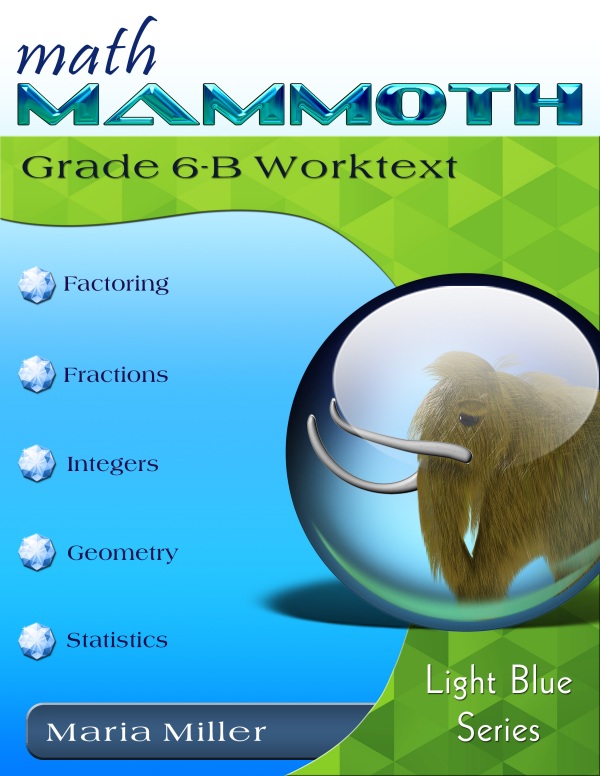
178 pages
153 lesson pages
6-A contents and samples
6-B contents and samples
Worksheet generator preview
Answer key sample
User Guide, grade 6
CCS Alignment / Contents
Scope & sequence
Errata
FAQ
Prices & ordering
You can purchase Math Mammoth Grade 6 as a download, or as already printed books.
Digital version
2022 edition
Grade 6 complete
USD $42.50 (download)
(the two worktexts, answer keys, tests, cumulative reviews, a worksheet maker, Soft-Pak)
Part 6-A only
USD $21.25 (download)
(Everything for the first half of 6th grade math; includes Soft-Pak)
Part 6-B only
USD $21.25 (download)
(Everything for the second half of 6th grade math; includes Soft-Pak)
2014-2021 edition
Click the link to add the product to cart.
You will be purchasing the downloads from my authorized reseller Comecero.
Printed copies
Rainbow Resource Center sells perfect-bound texts either with full color or with grayscale interior pages:
MM Grade 6 2022 ed.
MM grade 6 (b&w) 2021 ed.
MM grade 6 (color) 2021 ed.
Lulu sells spiral (coil) bound versions of the student books and of the tests & reviews book. The answer key is perfect bound.
2022 editions:
6-A worktext
6-B worktext
Tests & Cum Reviews
Answer Keys
Supportive materials
Includes the answer keys, tests, cumulative reviews, worksheet maker, and software Soft-Pak (digital download). Purchase this to go with printed student books. Do not purchase if you get the full digital version as listed above.
2022 edition (USD $9.60):
2021 edition (USD $9.60):
Lesson plan
You can purchase a lesson plan for Math Mammoth Grade 6 to use it in Homeschool Planet online planner. Learn more.
Skills Review Workbook
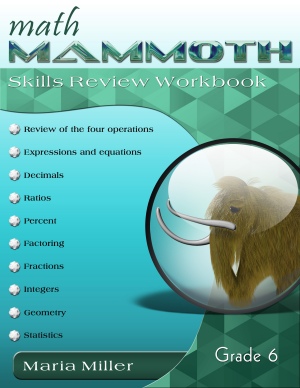
This workbook is supplemental, and provides additional practice for the topics in the curriculum. I recommend you only purchase it once you are sure the student does need supplemental practice. Learn more.
At the heart of the curriculum are two student worktexts (A and B), each covering about half a year of math work. These worktexts contain all the instruction and the exercises in the same book — which makes lesson preparation a breeze. The worktexts are written directly to the student, and thus they allow many students to teach themselves and to learn directly from the books.
You will also get separate answer keys, chapter tests, additional cumulative reviews (I do recommend you use at least some of them), and a versatile worksheet maker (Internet access required) for those times when your child needs just a bit more practice.
Features
- Math Mammoth focuses on conceptual understanding. It explains the "WHY", so your children can understand the math, not just learn "HOW" to do it.
- The curriculum is mastery-oriented. This means it concentrates fairly long on a topic, delving into its various aspects. This promotes conceptual understanding, as opposed to spiral curricula that often tend to jump from topic to topic too much.
- The curriculum has no separate teacher's manual, nor is it scripted. The introduction to each chapter has some notes for the teacher concerning the material in the chapter. All the instruction is written directly to the student in the worktext, and there also exist accompanying videos where you can see Maria herself teach the material.
- Very little teacher preparation is required.

- Concepts are often explained with visual models, followed by exercises using those models. These visual models can take the place of manipulatives for many children; however, it is very easy to add corresponding manipulatives to the lessons if so desired.
- After each chapter introduction, you will find a list of Internet links and resources (games, quizzes, animations, etc.) that can be used for fun, illustrations, and further practice.
Additional features for the digital version
- The PDF files can be filled in on a computer, phone, or tablet, using the annotation tools found in many PDF apps. Learn more.
- BONUS! The digital download also comes with BONUS Soft-Pak programs. The 6 programs in Soft-Pak (4 math, 1 language arts, 1 list maker) offer both on-screen and printable activities in a low-graphic, high content format. Read more and see screenshots.
Overview of topics
The main areas of study in Math Mammoth Grade 6 are:
- review of the basic operations with whole numbers
- beginning algebra topics: expressions, equations, and inequalities
- review of all decimal arithmetic
- introduction to ratios and percent
- prime factorization, GCF, and LCM
- a review of fraction arithmetic from 5th grade, plus a focus on division of fractions
- the concept of integers, coordinate grid, addition & subtraction of integers
- geometry: review of quadrilaterals & drawing problems; area of triangles & polygons; volume of rectangular prisms with fractional edge lengths; surface area
- statistics: concept of distribution, measures of center, measures of variation, summarizing distributions, boxplots, stem-and-leaf plots, histograms
Please also see the table of contents 6-A and 6-B (in the sample files), which will let you see the topics covered in more detail.
Read about the changes between 2022 and 2014-2021 editions.
Supplements
Lesson plan
We offer a lesson plan for Math Mammoth Grade 6 for the Homeschool Planet online planner. This is available in two versions: regular, and PLUS plan which also includes a PDF file of the plan. Learn more.
Skills Review Workbook
Math Mammoth Skills Review Workbook, Grade 6 provides additional practice for the topics in Math Mammoth Grade 6 curriculum. I recommend you only purchase it once you are sure your student does need supplemental practice. Learn more.
Introduction
In sixth grade, students encounter the beginnings of algebra, learning about algebraic expressions, one-variable equations and inequalities, integers, and ratios. We also review and deepen the students' understanding of rational numbers: both fractions and decimals are studied in depth, while percent is a new topic for 6th grade. In geometry, students learn to compute the area of various polygons, and also calculate volume and surface area of various solids. The last major area of study is statistics, where students learn to summarize and describe distributions using both measures of center and variability.
The year starts out with a review of the four operations with whole numbers (including long division), place value, and rounding. Students are also introduced to exponents and do some problem solving.
Chapter 2 starts the study of algebra topics, delving first into expressions and equations. Students practice writing expressions in many different ways, and use properties of operations and the idea of maintaining the equality of both sides of an equation to solve simple one-step equations. We also study briefly inequalities and using two variables.
Chapter 3 has to do with decimals. This is a long chapter, as we review all of decimal arithmetic, just using more decimal digits than in 5th grade. Students also convert measuring units in this chapter.
Ratios (chapter 4) is a new topic for sixth grade. Students are already familiar with finding fractional parts from earlier grades, and now it is time to advance that knowledge into the study of ratios, which arise naturally from dividing a quantity into many equal parts. We study such topics as rates, unit rates, equivalent ratios, and problem solving using bar models.
Percent (chapter 5) is an important topic to understand thoroughly, because of its many applications in real life. The goal of this chapter is to develop a basic understanding of percent, to see percentages as decimals, and to learn to calculate discounts.
In chapter 6, we first review prime factorization, and then study the greatest common factor and the least common multiple.
Chapter 7 first presents a thorough review of fraction operations from 5th grade (addition, subtraction, and multiplication). The topic of focus in the chapter is fraction division. Students also do some problem solving with fractions.
In chapter 8, students are introduced to integers. They plot points in all four quadrants of the coordinate plane and learn to add and subtract with negative numbers. Multiplication and division of integers are studied in 7th grade.
In geometry (chapter 9), the focus is on the area of polygons. This is studied in a logical progression: first, the area of right triangles, then the area of parallelograms, then, the area of triangles, and lastly the area of polygons. We also review some topics from earlier grades (quadrilaterals, triangles, perimeter, basic drawing). Other major topics in this chapter are calculating surface area of some solids using nets, and volume of rectangular prisms with fractional edge lengths.
Lastly, in chapter 10, students study statistics. The focus idea is that of a statistical distribution. Students learn about measures of center and measures of variability. They learn how to make dot plots, histograms, boxplots, and stem-and-leaf plots, and how to summarize distributions.
Manipulatives
Here is a list of manipulatives, or actually just measurement tools, that are needed for grade 6.
- A ruler that measures in inches
- A ruler that measures in centimeters
- A protractor.
Reviews / Testimonials of the 6th grade curriculum
Taking a look at Math Mammoth — a review of MM6 by Jaime Gravitt at My Homeschool Story blog
You are awesome. Thanks so much for your amazing curriculum. I am using 6th and 7th grade books for my 7th grade daughter who is homeschooling this year. I love that your curriculum corresponds to state standards so when my daughter goes back to school she not be behind. My daughter has gone from a student who did not like math to one who does math first thing in the morning! Thanks again!!
Adriane Orcutt-Fraser
How and where to order
You can buy Math Mammoth books at:
- Here at MathMammoth.com website — simply use the "Add to cart" buttons you see on the product pages.
- Rainbow Resource carries printed copies for the Light Blue series books.
- Homeschool Buyers Club offers download versions of the Light Blue series, plus the Blue series bundle.
- Homeschool Planet sells the digital versions of the main curriculum and lesson plans to go with them.
- K5 Learning offers download versions of the Blue series.
- TPT sells the Light Blue Series downloads, plus topical units.
- Lulu sells printed copies for most of the Math Mammoth materials (various series).
By purchasing any of the books, permission IS granted for the teacher (or parent) to reproduce this material to be used with his/her students in a teaching situation; not for commercial resale. However, you are not permitted to share the material with another teacher.
In other words, you are permitted to make copies for the students/children you are teaching, but not for other teachers' usage.
Math Mammoth books are PDF files. I recommend you use Adobe Reader to view them, including if you use a Mac. You can try other PDF viewers, but they may at times either omit or mess up some of the images.
Receive my monthly collection of math tips & resources directly in your inbox — and get a FREE Math Mammoth book!

You can unsubscribe at any time.
Math Mammoth TourConfused about the different options? Take a virtual email tour around Math Mammoth! You'll receive: An initial email to download your GIFT of over 400 free worksheets and sample pages from my books. Six other "TOURSTOP" emails that explain the important things and commonly asked questions concerning Math Mammoth curriculum. (Find out the differences between all these different-colored series!)This way, you'll have time to digest the information over one or two weeks, plus an opportunity to ask me personally about the curriculum. A monthly collection of math teaching tips & Math Mammoth updates (unsubscribe any time) We respect your email privacy.
Note: You will FIRST get an email that asks you to confirm your email address. If you cannot find this confirmation email, please check your SPAM/JUNK folder. |
"Mini" Math Teaching CourseThis is a little "virtual" 2-week course, where you will receive emails on important topics on teaching math, including:
- How to help a student who is behind You will also receive: A GIFT of over 400 free worksheets and sample pages from my books right in the very beginning.
A monthly collection of math teaching tips & Math Mammoth updates (unsubscribe any time)
We respect your email privacy.
Note: You will FIRST get an email that asks you to confirm your email address. If you cannot find this confirmation email, please check your SPAM/JUNK folder. |
Maria's Math TipsEnter your email to receive math teaching tips, resources, Math Mammoth news & sales, humor, and more! I tend to send out these tips about once monthly, near the beginning of the month, but occasionally you may hear from me twice per month (and sometimes less often). Peek at the previous tips here. You will also receive:
We respect your email privacy.
|
|