Math Mammoth Grade 4 complete curriculum
Math Mammoth Grade 4 Complete Curriculum is a complete math program for 4th grade, providing you with everything you need to teach 4th grade math. It is available both as a download version and as printed copies.

198 pages
180 lesson pages

192 pages
173 lesson pages
4-A contents and samples
4-B contents and samples
Worksheet generator preview
User Guide, grade 4
CCS Alignment / Contents
Scope & sequence
Errata
FAQ
Prices & ordering
You can purchase Math Mammoth Grade 4 as a download or as already printed books.
Digital version
Grade 4 complete:
USD $42.50 (download)
(the two worktexts, answer keys, tests, cumulative reviews, a worksheet maker, Soft-Pak)
Part 4-A only:
USD $21.25 (download)
(Everything for the first half of 4th grade math; includes Soft-Pak)
Part 4-B only:
USD $21.25 (download)
(Everything for the second half of 4th grade math; includes Soft-Pak)
You will be purchasing the downloads from my authorized reseller Comecero.
Lesson plan
The lesson plan assigns specific pages from the curriculum to each day in the plan, plus includes links to the teaching videos, and to online games, activities, and illustrative tools.
Regular version — $9.95 USD
interactive version to be used inside Homeschool Planet planner.
PLUS version — $14.95 USD
includes both the interactive and a PDF version.
Printed copies
Rainbow Resource Center sells perfect-bound texts either with full color or with grayscale interior pages:
MM grade 4 (b&w)
MM grade 4 (color)
At Lulu you will find spiral/coil bound student books and the tests & reviews book. The answer key is perfect bound.
4-A worktext
4-B worktext
Tests & Cum Reviews
Answer Keys
Supportive materials
This product is meant to go with the printed student books, and includes digital versions of the answer keys, tests, cumulative revisions, worksheet maker and software Soft-Pak (USD $9.60).
Do NOT purchase if you're getting the answer keys and tests & cumulative revisions as printed books, or if you're getting the digital version.
Skills Review Workbook
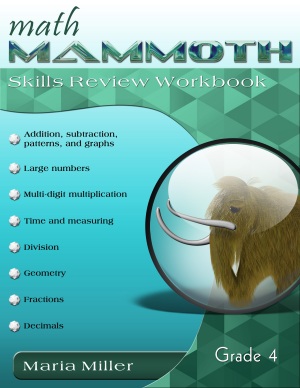
A supplemental workbook providing additional practice in a spiral manner for the topics in the curriculum. I recommend you only purchase it once you are sure the student does need supplemental practice. Learn more.
At the heart of the curriculum are two student worktexts (A and B), each covering about half a year of math work. These worktexts contain all the instruction and the exercises in the same book — which makes lesson preparation a breeze. The worktexts are written directly to the student, and thus they allow many children to teach themselves and to learn directly from the books.
You will also get separate answer keys, chapter tests, additional cumulative reviews (I do recommend you use at least some of them), and a versatile worksheet maker (Internet access required) for those times when your child needs just a bit more practice.
Features
- Math Mammoth focuses on conceptual understanding. It explains the "WHY", so your children can understand the math, not just learn "HOW" to do it.
- Concepts are often explained with visual models, followed by exercises using those models. These visual models can take the place of manipulatives for many children; however, it is very easy to add corresponding manipulatives to the lessons if so desired.
- The curriculum is mastery-oriented. This means it concentrates fairly long on a topic, delving into its various aspects. This promotes conceptual understanding, as opposed to spiral curricula that often tend to jump from topic to topic too much.
- There is a strong emphasis on mental math and number sense.
- It requires very little teacher preparation.

- The curriculum has no separate teacher's manual nor is it scripted. The introduction to each chapter has some notes for the teacher concerning the material in the chapter. All the instruction is written directly to the student in the worktext, and there also exist accompanying videos where you can see Maria herself teach the material.
- After each chapter introduction, you will find a list of Internet links and resources (games, quizzes, animations, etc.) that can be used for fun, illustrations, and further practice.
Additional features for the digital version (download/CD)
- The PDF files can be filled in on a computer, phone, or tablet, using the annotation tools found in many PDF apps. Learn more.
- BONUS! The download or CD version also comes with BONUS Soft-Pak programs. The 6 programs in Soft-Pak (4 math, 1 language arts, 1 list maker) offer both on-screen and printable activities in a low-graphic, high content format. Read more and see screenshots.
Overview of topics
In the fourth grade, students focus on multi-digit multiplication and division, learning to use bigger numbers, solving multi-step word problems that involve several operations, and they get started in studying fractions and decimals. This is of course accompanied by studies in geometry and measuring.
The year starts out with a review of addition and subtraction, patterns, and graphs. We illustrate word problems with bar diagrams and study finding missing addends, which teaches algebraic thinking. Children also learn addition and subtraction terminology, the order of operations, and statistical graphs.
Next come large numbers—up to millions, and the place value concept. At first the student reviews thousands and some mental math with them. Next are presented numbers up to one million, calculations with them, the concept of place value and comparing. In the end of the chapter we find out more about millions and an introduction to multiples of 10, 100, and 1000.
The third chapter is all about multiplication. After briefly reviewing the concept and the times tables, the focus is on learning multi-digit multiplication (multiplication algorithm). The children also learn why it works when they multiply in parts. We also study the order of operations again, touch on proportional reasoning, and do more money and change related word problems.
The last chapter in part A is about time, temperature, length, weight, and volume. Students will learn to solve more complex problems using various measuring units and to convert between measuring units.
In part B, we first study division. The focus is on learning long division and using division in word problems. In geometry, we first review area and perimeter, and then concentrate on the topic of angles. Students measure and draw angles, solve simple angle problems, and classify triangles according to their angles. They also study parallel and perpendicular lines.
Fractions and decimals are presented last in the school year. These two chapters practice only some of the basic operations with fractions and decimals. The focus is still on conceptual understanding and on building a good foundation towards 5th grade math, where fractions and decimals will be in focus.
When you use these books as your only or main mathematics curriculum, they can be like a "framework," but you do have some liberty in organizing the study schedule. Chapters 1, 2, and 3 should be studied in this order, but you can be flexible with chapters 4 (Time and Measuring) and 6 (Geometry) and schedule them somewhat earlier or later if you so wish. Chapter 3 (Multiplication) needs to be studied before long division in Chapter 5. Many topics from chapters 7 and 8 (Fractions and Decimals) can also be studied earlier in the school year; however finding parts with division should naturally be studied only after mastering division.
Please also see the table of contents 4-A and 4-B (in the sample files), which will let you see the topics covered in more detail.
Supplements
Lesson plan
We offer a lesson plan for Math Mammoth Grade 4, sold in two different versions.
- The lesson plan assigns specific pages from the curriculum to each day in the plan, thus pacing the curriculum for you.
- The plan also includes links to the teaching videos by the author.
- Lastly (and this is a great feature!), the plan includes online games, activities, and illustrative tools, all mapped to the individual lessons in the curriculum.
The plan comes in two versions: regular and PLUS.
Regular version
This is an interactive version of the plan be used inside Homeschool Planet planner — $9.95 USD. Learn more.
PLUS version
The PLUS version includes both the interactive version and a PDF file of the plan — $14.95 USD. Learn more.
Skills Review Workbook
Math Mammoth Skills Review Workbook, Grade 4 provides additional practice for the topics in Math Mammoth Grade 4 curriculum. I recommend you only purchase it once you are sure the student does need supplemental practice. Learn more.
Manipulatives
Here is a list of manipulatives that are needed or recommended for grade 4. Measuring tapes are only used in the measuring chapter.
- A protractor (for 4-B).
- A ruler that measures in inches (for 4-A and 4-B).
- A ruler that measures in centimeters (for 4-A and 4-B).
- A measuring tape that measures in feet (for 4-A).
- A measuring tape that measures in meters (for 4-A).
- A kitchen scale that measures in ounces (for 4-A; used only in one problem).
- Measuring cups that measure 1 cup, 1/2 cup, and 1/4 cup (for 4-A; used only in one problem).
- Fraction manipulatives. The curriculum contains printables to make your own fraction manipulatives. The text uses visual pie models extensively, and students even learn to draw them themselves for the exercises, therefore making or buying the manipulatives is entirely optional (optional; for 4-B).
Reviews & testimonials
Review of Math Mammoth by mommybugg238
Review of Math Mammoth from You've Got This Math (focusing on MM grade 4)
After lots of research, ChatGPT pointed me to Math Mammoth. I wanted something rigorous that was also problem-solving and thinking focused. My daughter LOVES this program (to the detriment of her other subjects!) and spends way too much time on math every day (how can I refuse when she begs me to do just one more page of math?)
As a math teacher, I'm consistently impressed with its high standards and logical progression.
So thankful that I found Math Mammoth!
Katie
September 2025
Summer
Gabrielle Frazier
Also, prior to buying we had our kids do placement tests with Math Mammoth and an online curriculum with a comic book-based text. They were in tears and very resistant, but they love Math Mammoth!"
- Nicole H, Co-op Member
September 2020
Thank you so much for all of your emails and care taken with your curriculum. He will be getting a Mammoth stuffed animal for Christmas!!
Regards
A happy homeschooling mom (Allisha)
September 2017
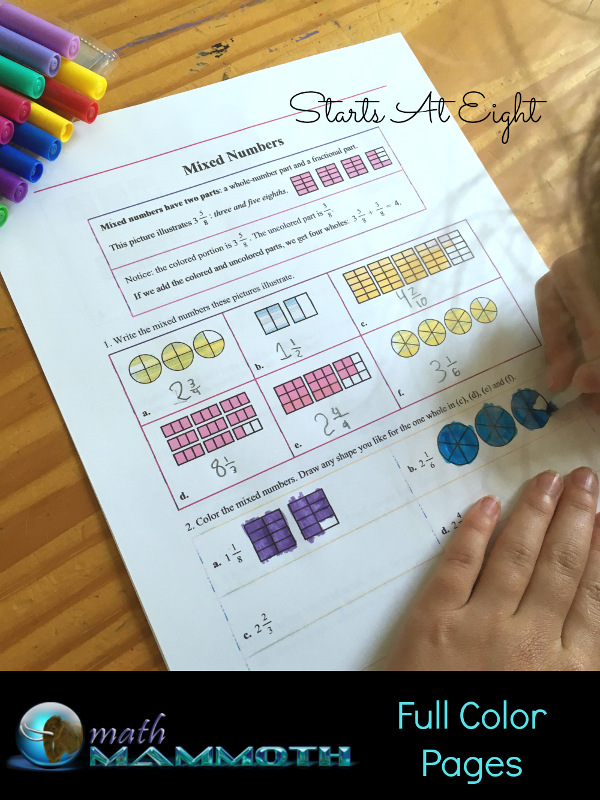
"Math Mammoth utilizes color in their books. This is a HUGE bonus in my opinion. It can be very monotonous to stare at page after page of black and white numbers, especially for little ones. Things like the fractions you see here are so much more interesting, and easier to explain when you have color designations."
Read the full review by Heidi at Starts at Eight blog
September 2016
- Claire L, Orlando, Co-op Member
September 2016
Shannon
May 2015
I love that we have topics as well as grades, so if my DD is struggling with something we can go back and cover it by topic to review, or use the reviews from previous grades. I love how the material is presented and it really makes sense. The mastery system is great because I feel my daughter can work to 'get it', rather than the old system we used which was spiral and often I found she didn't understand a lot of what we'd covered.
Finally, I like that it is not overly difficult for grade level, but about right. It gives my daughter confidence and there is still challenge in the puzzle corners, which we do together and she really enjoys. Other curriculum we have used has had a lot of extra stuff, which often my DD has not been ready for, so we've ended up going down a grade level, but then some of it was too easy. She's in fourth grade and sometimes she works independently, and other times I need to work through the explanations with her.
My daughter in first grade also uses some of the lessons, but at that age I tend to do more real life maths, aka Ruth Beechick. What we have used I really like, as it's all concrete - with pictures etc for the numbers.
We will continue to use this, definitely, it's the first programme I've been totally happy with.
My younger daughter loves it. My elder, really, really doesn't lke math, but she does really quite like Math Mammoth, so that's a pretty impressive accolade!
I have recommended Math Mammoth to all my home ed friends, because our family think it's great! I also recommended the Co-op deal.
- Mic T
March 2015
- Math Mammoth Grade 4 Review by Amanda who blogs at Trains & Tutus
I am in Cambodia so I have been very thankful for the ease in downloading the materials and printing them out. It saves on weight, which is always a plus. I'm looking into curriculum for next year and I expect to continue using MathMammoth for our math. Thank you for your work with it!
Added: We have now passed what I thought would be a "hurdle" going into standard multiplication and that day has come and gone completely painlessly!
Liesl
December 2013
Thanks again.
Blessings,
Aliza
January 2012
please let me take this opportunity to thank you for your fabulous Math Mammoth program.
My daughter is using it since 4th grade (now working on 5th grade) and we are looking ahead for next year's 6th grade. Math Mammoth has in my opinion hard-to-beat advantages over other math curricula:
* it is virtually self teaching. My daughter prefers doing her math on her own and rarely needs my help. She is getting it! Your explanations are wonderfully clear, Maria.
* it is very rigious and the chapter length is just right with 2-3 pages.
* your warmheartedness and dedication to provide a good curriculum shine through.
* it is very affordable.
I also wanted to mention, that I really appreciate your recommendations/comments on how to continue after finishing 6th grade. I value your opinion and input on this. Thank you for taking the time to review the curricula.
May I mention that my older daughter does Life of Fred parallel with Math Mammoth, an approach that proved extremely worthwhile for us. Concepts are constantly mutually introduced and/or reinforced, helping her to get a really good foundation in math. It is also not as time consuming as it might sound, since we take Fred on a more relaxed and slower basis. She is now working with Math Mammoth 5th grade (almost finished) and Life of Fred Pre-Algebra with Biology (about 1/2 way through).
In general, I would like to say, that Math Mammoth is easier to work with independently for grades 3 and up. It was in some way very difficult for my 2nd grader, since he would 'need' more pictures and definitely more one-one-one teaching. I felt that Math Mammoth was sometimes quite abstract and harder to understand for him. For this reason, I will give it another year before using Math Mammoth with him. On the other hand, my youngest son might benefit from Math Mammoth right away since math seems to be 'his thing' and he is very quick in getting and using even abstracter concepts.
To sum it up, I cannot thank you enough for your program and I am extremely happy that I found Math Mammoth.
Best Regards,
Karin from NJ
April 2011
I just had to send you a message to tell you about our recent proof of success using Math Mammoth. Our state requires standardized tests each year for homeschoolers and we just received this year's scores for my daughter in the mail. We started using Math Mammoth during the second half of my daughter's 4th grade year and used it for the complete 5th grade year which has just concluded. Even though we used the 4th grade level Light Blue book for her 5th grade year, her Math Total score jumped 36 percentage points from last year to this year! Especially taking into consideration that she was taking a 5th grade level test, I find that level of improvement absolutely remarkable! Thank you so much for such a wonderful product that is so wonderfully easy to use!
Sincerely,
Robin Lindblad
June 2010
Noella
May 2010
Review: Math Mammoth grade 4 from Let's Play Math blog
TOS Review: Math Mammoth by Books and Bairns blog
My son was lost in the math jungle, until we got your program. He just did not understand the other program we were trying. It had new material everyday and he did not understand the concept learned or the new one being taught. He needed my help to complete every problem and was falling behind in math. So, I got on the computer and browsed through your material again. I had been looking at it, but no one that I knew of was using the light blue series.
Well, it took me all of about 10 minutes to get my file. We began the series the next day, after about a week or so I could tell that things were finally sticking. He is already catching up in areas where he was having great difficulty before. The reason for this I believe is how each lesson/chapter is set up. Each lesson and chapter build on one another, but the student is given plenty of examples on how to do the work and plenty of practice without beating a dead horse, so to speak. He now feels smart in math and for that you can not put a price tag on. I also feel that your materials are very affordable, most math programs cost a great deal more, but in my opinion are not quite so thorough. Thanks for creating such a simple yet effective way to learn math.
Alicia
1 December, 2008
How and where to order
You can buy Math Mammoth books at:
- Here at MathMammoth.com website — simply use the "Add to cart" buttons you see on the product pages.
- Rainbow Resource carries printed copies for the Light Blue series books.
- Homeschool Buyers Club offers download versions of the Light Blue series, plus the Blue series bundle.
- Homeschool Planet sells the digital versions of the main curriculum and lesson plans to go with them.
- K5 Learning offers download versions of the Blue series.
- TPT sells the Light Blue Series downloads, plus topical units.
- Lulu sells printed copies for most of the Math Mammoth materials (various series).
By purchasing any of the books, permission IS granted for the teacher (or parent) to reproduce this material to be used with his/her students in a teaching situation; not for commercial resale. However, you are not permitted to share the material with another teacher.
In other words, you are permitted to make copies for the students/children you are teaching, but not for other teachers' usage.
Math Mammoth books are PDF files. I recommend you use Adobe Reader to view them, including if you use a Mac. You can try other PDF viewers, but they may at times either omit or mess up some of the images.
Receive my monthly collection of math tips & resources directly in your inbox — and get a FREE Math Mammoth book!

You can unsubscribe at any time.
Math Mammoth TourConfused about the different options? Take a virtual email tour around Math Mammoth! You'll receive: An initial email to download your GIFT of over 400 free worksheets and sample pages from my books. Six other "TOURSTOP" emails that explain the important things and commonly asked questions concerning Math Mammoth curriculum. (Find out the differences between all these different-colored series!)This way, you'll have time to digest the information over one or two weeks, plus an opportunity to ask me personally about the curriculum. A monthly collection of math teaching tips & Math Mammoth updates (unsubscribe any time) We respect your email privacy.
Note: You will FIRST get an email that asks you to confirm your email address. If you cannot find this confirmation email, please check your SPAM/JUNK folder. |
"Mini" Math Teaching CourseThis is a little "virtual" 2-week course, where you will receive emails on important topics on teaching math, including:
- How to help a student who is behind You will also receive: A GIFT of over 400 free worksheets and sample pages from my books right in the very beginning.
A monthly collection of math teaching tips & Math Mammoth updates (unsubscribe any time)
We respect your email privacy.
Note: You will FIRST get an email that asks you to confirm your email address. If you cannot find this confirmation email, please check your SPAM/JUNK folder. |
Maria's Math TipsEnter your email to receive math teaching tips, resources, Math Mammoth news & sales, humor, and more! I tend to send out these tips about once monthly, near the beginning of the month, but occasionally you may hear from me twice per month (and sometimes less often). Peek at the previous tips here. You will also receive:
We respect your email privacy.
|
|