Math Mammoth Grade 3 Complete Curriculum
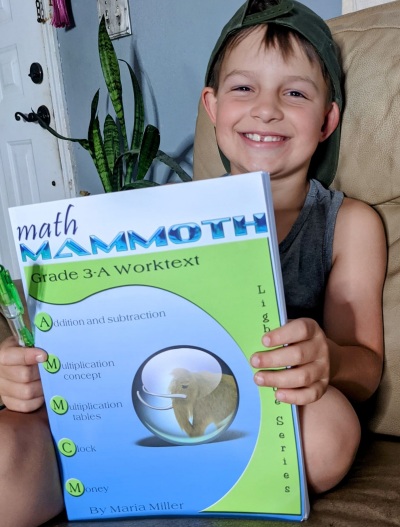
Math Mammoth Grade 3 Complete Curriculum is a complete math program for 3rd grade, providing you with everything you need to teach 3rd grade math. It is available both as a download version and as printed copies.
At the heart of the curriculum are two student worktexts (A and B), each covering about half a year of math work. These worktexts contain all the instruction and the exercises in the same book — which makes lesson preparation a breeze. The worktexts are written directly to the student, and thus they allow many children to teach themselves and to learn directly from the books.
You will also get separate answer keys, chapter tests, additional cumulative reviews (I do recommend you use at least some of them), and a versatile worksheet maker (Internet access required) for those times when your child needs just a bit more practice.

222 pages
205 lesson pages

211 pages
193 lesson pages
2024 edition:
3-A contents & samples
3-B contents & samples
User Guide (2024 edition)
CCS Documentation (2024 ed.)
Scope & sequence
Worksheet generator preview
Errata
FAQ
2018 edition:
3-A contents & samples
3-B contents & samples
User Guide (2018 edition)
CCS Documentation (2018 ed.)
Prices & ordering
You can purchase Math Mammoth Grade 3 as a digital download or as printed books.
Digital version
2024 edition
Grade 3 complete
USD $42.50 (download)
(the two worktexts, answer keys, tests, cumulative reviews, a worksheet maker, Soft-Pak)
Part 3-A only
USD $21.25 (download)
(Everything for the first half of 3rd grade math; includes Soft-Pak)
Part 3-B only
USD $21.25 (download)
(Everything for the second half of 3rd grade math; includes Soft-Pak)
2018 edition
Click the link to add the product to cart.
You will be purchasing the downloads from my authorized reseller Comecero.
Printed copies
See full details about the printed copies on this page.
Rainbow Resource Center sells perfect-bound texts either with full color or with grayscale interior pages:
MM Grade 3 (b&w) 2024 ed.
MM Grade 3 (color) 2024 ed.
Lulu sells spiral (coil) bound versions of the student books and of the tests & reviews book.
2024 editions:
3-A worktext
3-B worktext
Tests & Cum. Reviews
Answer Keys (perfect bound)
2018 editions:
3-A worktext
3-B worktext
Tests & Cum. Reviews
Answer Keys (perfect bound)
We also provide a list of ISBN numbers so you can order at Amazon or other bookstores.
Supportive materials
Includes the answer keys, tests, cumulative reviews, worksheet maker, and software Soft-Pak (digital download). Purchase this to go with printed student books. Do not purchase if you get the full digital version as listed above.
2024 edition (USD $9.60):
2018 edition (USD $9.60):
Lesson plan
You can purchase a lesson plan for Math Mammoth Grade 3 to use it in Homeschool Planet online planner. Learn more.
Skills Review Workbook
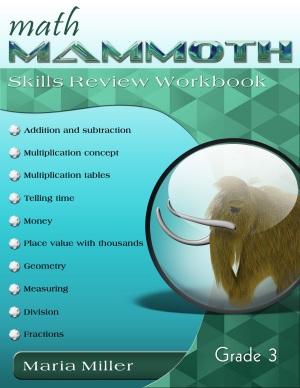
This workbook is supplemental, and provides additional practice for the topics in the curriculum. I recommend you only purchase it once you are sure the student does need supplemental practice. Learn more.
Features
- Math Mammoth focuses on conceptual understanding. It explains the "WHY", so your children can understand the math, not just learn "HOW" to do it.
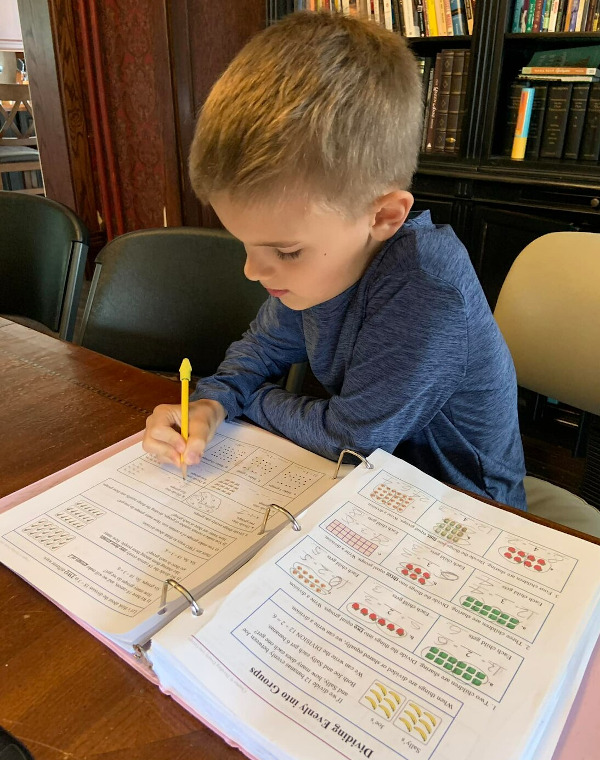
- Concepts are often explained with visual models, followed by exercises using those models. These visual models can take the place of manipulatives for many children; however, it is very easy to add corresponding manipulatives to the lessons if so desired.
- The curriculum is mastery-oriented. This means it concentrates fairly long on a topic, delving into its various aspects. This promotes conceptual understanding, as opposed to spiral curricula that often tend to jump from topic to topic too much.
- There is a strong emphasis on mental math and number sense.
- It requires very little teacher preparation, which is a big help to most parents.

- The curriculum has no separate teacher's manual nor is it scripted. The introduction to each chapter has some notes for the teacher concerning the material in the chapter. All the instruction is written directly to the student in the worktext, and there also exist accompanying videos where you can see Maria herself teach the material.
- After each chapter introduction, you will find a list of Internet links and resources (games, quizzes, animations, etc.) that can be used for fun, illustrations, and further practice.
- For multiplication tables and division facts, you can use our online practice program (free). Visit the pages for Multiplication Tables Online Practice and Division Facts Online Practice
Additional features for the digital version (download)
- The chapter on coins is included in seven currencies: US, Canadian, British, European, Australian, New Zealand, and South African money. You will automatically get all these versions when you buy the digital (download) version of Grade 3 Complete Curriculum .
- The PDF files can be filled in on a computer, phone, or tablet, using the annotation tools found in many PDF apps. Learn more.
- BONUS! The digital version also comes with BONUS Soft-Pak programs. The 6 programs in Soft-Pak (4 math, 1 language arts, 1 list maker) offer both on-screen and printable activities in a low-graphic, high content format. Read more and see screenshots.
And believe it or not... he has actually enjoyed learning and practicing new mental math strategies. In fact, I’ve had to learn NOT to offer hints or tips when he is working, because he wants to solve each problem on his own without assistance. (Pretty cool!)"
Overview of topics
Third grade is a time for learning and mastering two (mostly new) operations: multiplication and division within 100. The student also deepens his understanding of addition and subtraction, and uses those in many different contexts, such as with money, time, and geometry.
The main areas of study in Math Mammoth Grade 3 are:
- Students develop an understanding of multiplication and division of whole numbers through problems involving equal-sized groups, arrays, and area models. They learn the relationship between multiplication and division, and solve many word problems involving multiplication and division (chapters 3, 4, and 8). They learn the multiplication tables, and learn how to use their knowledge of multiplication tables to solve basic division facts.
- Students develop an understanding of fractions, beginning with unit fractions. They use fractions along with visual fraction models and on a number line. They also compare fractions by using visual fraction models and strategies based on noticing equal numerators or denominators (chapter 11).
- Students learn the concepts of area and perimeter. They relate area to multiplication and to addition, recognize perimeter as a linear measure (in contrast with area), and solve problems involving area and perimeter (chapter 10).
- Students fluently add and subtract within 1,000, both mentally and in columns (with regrouping). They learn to add and subtract 4-digit numbers, and use addition and subtraction in problem solving (chapters 1, 2 and 7).
Additional topics we study are time (chapter 5), money (chapter 6), measuring (chapter 9), and bar graphs and pictographs (in chapter 8).
The 2018 edition (and earlier ones) used to include a lesson on Roman numerals, which has been dropped from the 2024 edition. However, if you want your child or students to study the topic, you can download the lesson here: Roman Numerals and Roman Numerals Answer Key.
Please also see the table of contents 3-A and 3-B (in the sample files), which will let you see the topics covered in more detail.
Manipulatives
Here is a list of manipulatives that are needed or recommended for grade 3. Measuring tapes, scales, and measuring cups are only used in the measuring chapter.
- An old-fashioned alarm clock or other analog clock where you can turn the minute hand and the hour hand will turn as it is supposed to (optional; for 3-A).
- A ruler that measures in inches (for 3-B).
- A ruler that measures in centimeters (for 3-B).
- A measuring tape that measures in feet (for 3-B).
- A measuring tape that measures in meters (for 3-B).
- A kitchen scale that measures in ounces (for 3-B).
- A kitchen scale that measures in grams (for 3-B).
- A measuring cup that measures 1 cup (for 3-B), a pint jar, and a quart jar.
- A measuring cup that measures in milliliters (for 3-B).
- Fraction manipulatives. The curriculum contains printables to make your own fraction manipulatives. The text uses visual pie models extensively, and students even learn to draw them themselves for the exercises, therefore making or buying the manipulatives is entirely optional (optional; for 3-B).

Supplements
Lesson plan
We offer a lesson plan for Math Mammoth Grade 3, sold in two different versions, and for two editions (a total of 4 different plans).
- The lesson plan assigns specific pages from the curriculum to each day in the plan, thus pacing the curriculum for you.
- The plan also includes links to the teaching videos by the author.
- Lastly (and this is a great feature!), the plan includes online games, activities, and illustrative tools, all mapped to the individual lessons in the curriculum.
The plan comes in two versions: regular and PLUS.
Regular version
This interactive version of the plan is used inside the Homeschool Planet planner — $9.95 USD. Learn more.

PLUS version
The PLUS version includes both the interactive version and a PDF file of the plan — $14.95 USD. Learn more.
Skills Review Workbook
Math Mammoth Skills Review Workbook, Grade 3 provides additional practice for the topics in Math Mammoth Grade 3 curriculum. I recommend you only purchase it once you are sure the student does need supplemental practice. Learn more.
Reviews / Testimonials of the 3rd grade curriculum
Deb Tunwall, Iowa City, IA
June 2024
Hilary E
October 2021
- A Gonzalez, Co-op Member
September 2019
Jen
May 2019
- Janet, Co-op Member
March 2018

...it is the perfect blend of easy and challenging for Mr. C.
It's easy to understand but the lessons still give him a real challenge.
In one lesson Mr. C was working on mental addition of 2 and 3 digit numbers and he loved challenging himself to get the answers quicker and quicker. While some curriculums might simply say "do the problem in your head", Math Mammoth broke the lesson down step by step to give Mr. C different tips and tricks to solve mental addition in easier ways.
Read the full review at This Outnumbered Mama blog.
By Kaylene
September 2016
E. Allen
Cheryle Pope
Thanks again,
This satisfied mom:)
Math Mammoth review by Gingerbread Mommy
- archer11101, Co-op Member
Thanks!
Margaret Glisson
Dee
I just wanted to say thank you for taking the time to create such a thorough, yet affordable, math program.
My husband and I have engineering degrees and our children have logical minds so we feel pretty strong in teaching math. Well, we started off and hung in with Saxon because it reminded us of how we learned math. Our oldest son became confused and our middle daughter "got it" but absolutely hated it, when previously she was doing math workbooks for fun.
I tried your free worksheets for lack of something better to do and could see how you give them a small chunk of new material per day, then build on it until they master it. This works perfectly with my son's learning style, and my daughter mentioned, "I like how this lady starts off easy then makes it harder. Her word problems are interesting."
I tell anyone who asks how much I like the program. It is rigorous, not dumbed down, but not overwhelming, and a good value for the money.
I hope you are seeing increased business and keep up the great work! Also, the You Tube videos are cool. It would be great to have one for all of your chapters.
Thanks!
Denise, Colorado Springs
Thanks,
Amanda
Hello! I wanted to let you know that I ordered the Light Blue Series 3rd Grade and we've only used it about 4 days but my daughter is really starting to "get" math. She was using BJU and I absolutely love all of BJU's materials, however, the spiral approach to learning math just wasn't working with my oldest daughter. There wasn't enough repetition and the material seemed to only touch on the topics briefly before moving on. I was a bit behind on grading papers this semester and I noticed as I started grading tests and papers that she was really making some horrible mistakes in addition and subtraction. I looked at her and said "tell me what 5 + 3 is" and she held up her fingers counting them one by one and had to think about it a long time. I was mortified! Especially since my husband and I are both skilled in math more than just about any other subject. We started going through the lessons, and both of us cried many tears the first few days, but when she picked up on the "mental math" it all started to make sense to her. It was as if a light bulb came on! She has done well with math up until this point and so it really surprised me that she just wasn't getting it. I'm really excited about using your curriculum and hopefully she'll gain a much deeper understanding of math rather than having to use her fingers to add and subtract all the time. I'm glad I found you on the internet!
Amy from Oklahoma
My favorite feature is the printable worksheets on specific topics. My daughter has struggled with confidence, but after a week of targeted worksheets, she knows that she can do it! Now for subtraction with borrowing from zero...
Vicky Schwartz
You asked how we liked your program.... Well, just to give you a little history... I found out about your math curriculum through Winter Promise and after looking at the samples from your site as well as ordering one of your small topic e-books, I went ahead & ordered the 3rd grade Lightblue curriculum from Winter Promise. Math is probably the least favorite subject for my daughter & we were having a real struggle with the program we were using before. Even though the program was colorful & looked interesting, it did not seem to explain the concepts behind the math facts. As soon as we switched to the Lightblue curriculum, I noticed an improvement in her attitude towards math. Also, I've noticed that she's been able to retain the information she's learning much better. I'm not sure if that's because we switched from a spiral approach to a mastery approach, but I'm sure that has something to do with it. :) On top of that, we just got her CAT test scores back a couple of weeks ago, and in math she scored in the 98th percentile with a perfect score! We also had her tested one on one with her evaluator and she scored in the 87th percentile with a grade equivalent of 5.1. So, as you can see, we are very happy with your program. :)
Tracy Homa
My daughter was in Saxon math but she was having difficulty learning new concepts and the teacher's book was just too much to sift through and I found it really didn't help much anyways. I switched to the Lightblue series grade 3 about a month ago and use it as our only math curriculum.
Please describe how you have liked the ebooks.
We really love it. I loved the helps on memorizing the multiplication table and within a couple of days my daughter had her 2's down. It is so nice to have the text with the workbook... my daughter really understands each concept as she does her problems. What used to take at least an hour to complete, she now does in 20 minutes. She recently completed her chapter 2 test and only missed one problem... but when I had her look at it again she realized what she did wrong... now that's what I call total comprehension! Thank you for created this series. I'm definitely going to order the grade 4 curriculum.
I wouldn't change a thing. Honestly. In my family we've done Lifepac, BJU, and Saxon and this is by far the best I've found.
Michelle Hall
How and where to order
You can buy Math Mammoth books at:
- Here at MathMammoth.com website — simply use the "Add to cart" buttons you see on the product pages.
- Rainbow Resource carries printed copies for the Light Blue series books.
- Homeschool Buyers Club offers download versions of the Light Blue series, plus the Blue series bundle.
- Homeschool Planet sells the digital versions of the main curriculum and lesson plans to go with them.
- K5 Learning offers download versions of the Blue series.
- TPT sells the Light Blue Series downloads, plus topical units.
- Lulu sells printed copies for most of the Math Mammoth materials (various series).
By purchasing any of the books, permission IS granted for the teacher (or parent) to reproduce this material to be used with his/her students in a teaching situation; not for commercial resale. However, you are not permitted to share the material with another teacher.
In other words, you are permitted to make copies for the students/children you are teaching, but not for other teachers' usage.
Math Mammoth books are PDF files. I recommend you use Adobe Reader to view them, including if you use a Mac. You can try other PDF viewers, but they may at times either omit or mess up some of the images.
Receive my monthly collection of math tips & resources directly in your inbox — and get a FREE Math Mammoth book!

You can unsubscribe at any time.
Math Mammoth TourConfused about the different options? Take a virtual email tour around Math Mammoth! You'll receive: An initial email to download your GIFT of over 400 free worksheets and sample pages from my books. Six other "TOURSTOP" emails that explain the important things and commonly asked questions concerning Math Mammoth curriculum. (Find out the differences between all these different-colored series!)This way, you'll have time to digest the information over one or two weeks, plus an opportunity to ask me personally about the curriculum. A monthly collection of math teaching tips & Math Mammoth updates (unsubscribe any time) We respect your email privacy.
Note: You will FIRST get an email that asks you to confirm your email address. If you cannot find this confirmation email, please check your SPAM/JUNK folder. |
"Mini" Math Teaching CourseThis is a little "virtual" 2-week course, where you will receive emails on important topics on teaching math, including:
- How to help a student who is behind You will also receive: A GIFT of over 400 free worksheets and sample pages from my books right in the very beginning.
A monthly collection of math teaching tips & Math Mammoth updates (unsubscribe any time)
We respect your email privacy.
Note: You will FIRST get an email that asks you to confirm your email address. If you cannot find this confirmation email, please check your SPAM/JUNK folder. |
Maria's Math TipsEnter your email to receive math teaching tips, resources, Math Mammoth news & sales, humor, and more! I tend to send out these tips about once monthly, near the beginning of the month, but occasionally you may hear from me twice per month (and sometimes less often). Peek at the previous tips here. You will also receive:
We respect your email privacy.
|
|