
Math Mammoth Grade 2 Complete Curriculum
Math Mammoth Grade 2 Complete Curriculum gives you everything you need for 2nd grade math. It is available both as a download version and as printed copies.
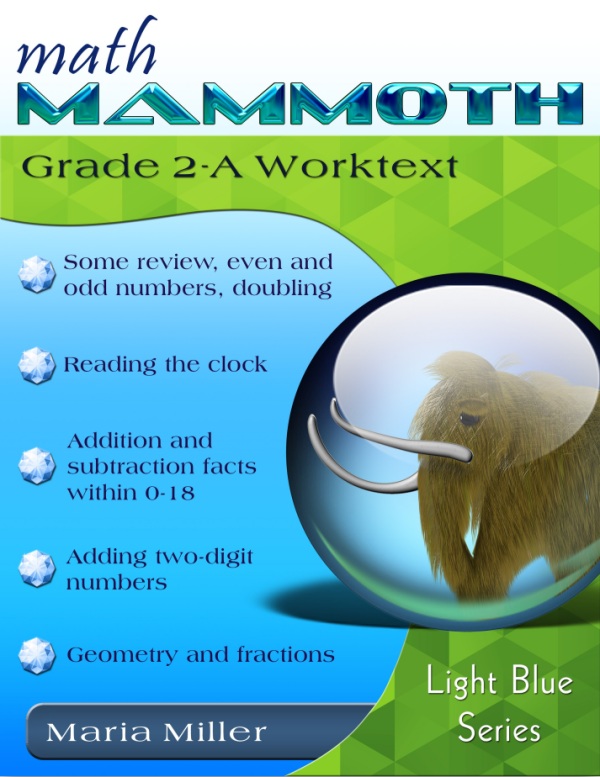
159 pages
133 lesson pages
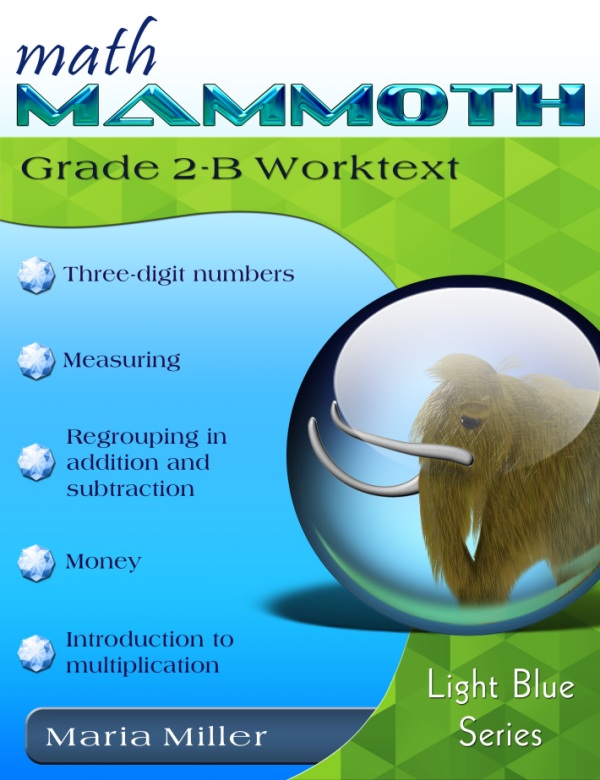
166 pages
148 lesson pages
2-A contents and samples
2-B contents and samples
Worksheet generator preview
User Guide, grade 2
CCS Alignment / Contents
Scope & sequence
FAQ
Prices & ordering
You can purchase Math Mammoth Grade 2 as a download, or as already printed books.
Digital version
Grade 2 complete:
USD $42.50 (download)
(the two worktexts, answer keys, tests, cumulative reviews, a worksheet maker, Soft-Pak)
Part 2-A only:
USD $21.25 (download)
(Everything for the first half of 2nd grade math; includes Soft-Pak)
Part 2-B only:
USD $21.25 (download)
(Everything for the second half of 2nd grade math; includes Soft-Pak)
You will be purchasing the downloads from my authorized reseller Comecero.
Lesson plan
The lesson plan assigns specific pages from the curriculum to each day in the plan, plus includes links to the teaching videos, and to online games, activities, and illustrative tools.
Regular version — $9.95 USD
interactive version to be used inside Homeschool Planet planner.
PLUS version — $14.95 USD
includes both the interactive and a PDF version.
Printed copies
You can purchase printed copies at Lulu or Rainbow Resource.
Rainbow Resource Center sells perfect-bound texts either with full color or with grayscale interior pages:
Math Mammoth grade 2 (b&w)
Math Mammoth grade 2 (color)
Lulu sells spiral (coil) bound versions of the student books and of the tests & reviews book.
2-A worktext
2-B worktext
Tests & Cumulative Reviews
Answer Keys
(perfect bound)
Supportive materials (digital)
This product is meant to go with the printed student books, and includes digital versions of the answer keys, tests, cumulative revisions, worksheet maker and software Soft-Pak (USD $9.60).
Do NOT purchase if you're getting the answer keys and tests & cumulative revisions as printed books, or if you're getting the digital version.
Skills Review Workbook
This workbook is supplemental, and provides additional practice for the topics in the curriculum. I recommend you only purchase it once you are sure the student does need supplemental practice. Learn more.
At the heart of the curriculum are two student worktexts (A and B), each covering about half a year of math work. These worktexts contain all the instruction and the exercises in the same book — which makes lesson preparation a breeze. The worktexts are written directly to the student, and thus they allow many children to teach themselves and to learn directly from the books.
You will also get separate answer keys, chapter tests, additional cumulative reviews (I do recommend you use at least some of them), and a versatile worksheet maker (Internet access required) for those times when your child needs just a bit more practice.

Features
- Math Mammoth focuses on conceptual understanding. It explains the "WHY", so your children can understand the math, not just learn "HOW" to do it.
- Concepts are often explained with visual models, followed by exercises using those models. These visual models can take the place of manipulatives for many children; however, it is very easy to add corresponding manipulatives to the lessons if so desired.
- The curriculum is mastery-oriented. This means it concentrates fairly long on a topic, delving into its various aspects. This promotes conceptual understanding, as opposed to spiral curricula that often tend to jump from topic to topic too much.
- There is a strong emphasis on mental math and number sense.
- It requires very little teacher preparation, which is a big benefit to most teachers and parents. :)
- The curriculum has no separate teacher's manual nor is it scripted. The introduction to each chapter has some notes for the teacher concerning the material in the chapter. All the instruction is written directly to the student in the worktext, and there also exist accompanying videos where you can see Maria herself teach the material.
- After each chapter introduction, you will find a list of Internet links and resources (games, quizzes, animations, etc.) that can be used for fun, illustrations, and further practice.
- For addition and subtraction facts, you can use our online practice program (free). Visit the pages for Single-digit Addition Facts online practice and Fact Families online practice
Additional features for the digital version
- The chapter on coins (chapter 9) is included in seven currencies: US, Canadian, British, European, Australian, New Zealand, and South African money. You will automatically get all these versions when you buy the digital version of Grade 2 Complete Curriculum.
- The PDF files can be filled in on a computer, phone, or tablet, using the annotation tools found in many PDF apps. Learn more.
- BONUS! The download version also comes with BONUS Soft-Pak programs. The 6 programs in Soft-Pak (4 math, 1 language arts, 1 list maker) offer both on-screen and printable activities in a low-graphic, high content format. Read more and see screenshots.
Overview of topics
The main areas of study in grade 2 curriculum are:
- Understanding of the base-ten system within 1000. This includes place value with three-digit numbers, skip- counting by fives, tens, and multiples of hundreds, tens, and ones (within 1000). (chapters 6 and 8);
- Develop fluency with addition and subtraction within 100, including solving word problems, regrouping in addition, and regrouping in subtraction (chapters 1, 3, 4, and 8);
- Using standard units of measure (chapter 7);
- Describing and analyzing shapes (chapter 5).
Additional topics we study are time/clock (chapter 2), money (chapter 9), introduction to multiplication (chapter 10), and bar graphs and picture graphs (in various chapters).
Check out the table of contents for 2-A and 2-B (sample files) to see the topics covered in more detail.
Supplements
Lesson plan
We offer a lesson plan for Math Mammoth Grade 2, sold in two different versions.
- The lesson plan assigns specific pages from the curriculum to each day in the plan, thus pacing the curriculum for you.
- The plan also includes links to the teaching videos by the author.
- Lastly (and this is a great feature!), the plan includes online games, activities, and illustrative tools, all mapped to the individual lessons in the curriculum.
The plan comes in two versions: regular and PLUS.
Regular version
This is an interactive version of the plan be used inside Homeschool Planet planner — $9.95 USD. Learn more.
PLUS version
The PLUS version includes both the interactive version and a PDF file of the plan — $14.95 USD. Learn more.
Skills Review Workbook
Math Mammoth Skills Review Workbook, Grade 2 provides additional practice for the topics in Math Mammoth Grade 2 curriculum. I recommend you only purchase it once you are sure the student does need supplemental practice. Learn more.
Manipulatives
Here is a list of manipulatives and tools that are needed or recommended for grade 2:
- An old-fashioned alarm clock or other analog clock where you can turn the minute hand and the hour hand will turn as it is supposed to (for 2-A).
- A ruler that measures in inches (for 2-B).
- A ruler that measures in centimeters (for 2-B).
- A bathroom scales. It is best if you can have one that measures in pounds and in kilograms, or one with pounds and another with kilograms; however I realize most people wouldn't normally buy two bathroom scales, so if you decide not to get both kinds, it means you will just need to skip some activities in the measuring chapter (for 2-B).
- Base ten blocks to illustrate place value with hundreds (optional). The worktexts have pictures that are just like base ten blocks, and most children can understand the concepts from the visual representation, without a physical manipulative; however for some children, the actual blocks can be beneficial (for 2-B).
A 100-bead abacus (optional)
Please read more about the 100-bead abacus on the FAQ page.
Reviews / Testimonials
Math Mammoth Grade 2 review by MamaSweetBaby
- Sarah F., Co-op Member
Carol
- Liz P., Co-op Member
Kym Ely, Co-op Member
October 2017
...
After reading through and testing out the second grade Math Mammoth curriculum, I can say with confidence that it is clear she is a math teacher who understands math and how to teach it.
The curriculum is rigorous, and I can tell that the goal is to explain math in a conceptual way, rather than merely memorization of facts.
...
While I am a fan of Singapore math, I can definitely see how it would be difficult for the average parent (who doesn't have a math teaching degree) to pick up and use. (There are no instructions or explanations in the textbooks.)
Math Mammoth, on the other hand, provides lots of help and support for parents who can do math, but don't necessarily know how to teach the why behind it.
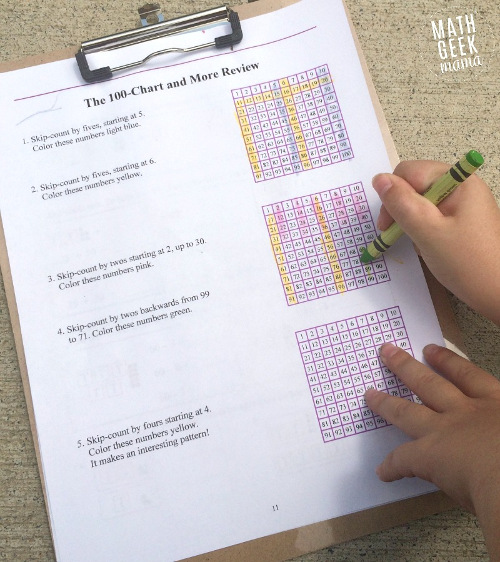
Read the full review at MathGeekMama blog.
Bethany Lake
September 2016
- Karen F
October 2015
- B. Sikes, Co-op Member
September 2015
- H.B., Co-op Member
November 2014
this is Max father of Leonardo a 7 years boy.
We are Italian but for working reason we live in Vietnam. My son goes to an International school and he is in second grade. On last November we noticed that Leo was behind compare to the other students so we starting a more strong program. My wife and I personally have spent a lot of time with him doing together his homework.
Our homework time is at least 1 or 1,5 hours a day.
AT that time I was looking for some extra math exercise to do with him since the school is really lacking of additional material. Also his homework are very simple and easy. Don't mention the fact that during the holidays they don't give to the students any homework to do (this is opposite to the Italian system where they give you tons of homework to do and the parents get crazy with it!).
Anyhow I was looking on internet for some math worksheet and after some researches I found your website. I was impressed with your work and clear exercises and the learning curve you have adopted was what I was looking.
Now we use regularly your material to review and repeat and make more exercises. I'm very happy with the improvements our son has done over the past months!
Thank you for you great job!
Max
April 2011
Sincerely,
April McMillan
April 2011
Rachel
October 2010
It seems to me that my boys (an older one too) have all thought they can add small numbers easily, and so have ignored the strategies when they have been taught them. Later, they suffer for this... So going over them after a struggle with more advanced work is something they are now appreciating.
One thing I appreciate about your math is that each problem has a double purpose, it seems, and so no opportunity is wasted. Somehow each problem also makes the child think, and I find that this is important, to keep them from doing math with a "Ho Hum" attitude. Once they develop this attitude, they seem to do the math in a trance and learn little. I feel, even at this very early stage, that I am seeing them embrace the challenge and learn something. There is evidence of them thinking mathematically for the first time... something I had almost lost hope for.
I think that if other programs I have used have taught mental strategies, they have been in a way that a child can easily ignore the strategy. You are teaching the strategy with each set of problems, in such a way that they have to think strategy, rather than just see answers. You are very creative in this way, it is quite unique.
Gratefully,
Leisa Douglas
October 2010
Thanks!
Jennifer Johnson
October 2010
Meg Williams
April 2010
Your explanations are clear and I love the way you teach. I like that there is no separate teacher's book; that everything is right in the text. I can see my older son really learning to think mathematically, especially when it comes to mental math, and even I am learning things by teaching it! My second son just turned six and Math Mammoth 1 is a perfect fit for him. He really was ready and needing to cement his addition and subtraction facts and that is exactly what he is focusing on with Math Mammoth 1.
I just bought the complete Light Blue series download through Homeschool Buyer's Coop. Thank you for the great deal! And I was very pleased to open it all up and see that you included the Canadian money chapters for each level. We are in Canada and that is one reason I chose to use Math Mammoth in the first place. Makes my life easier!
Thank you for an excellent program!
Erin Elias
April 2010
We bought the Light Blue Grade 2 last week and we're LOVING it! I am using it to remediate my daughter, who is 10. She had such a mental block against understanding math, until your program! Just in one week she has light bulbs coming on left and right and is finally getting some confidence! THANK you! I'm considering switching my younger son over to Math Mammoth too!
Leslie Papa
February 2010
Now, my dear son is very bright in many ways, but at the start of the new school year, to my horror, he appeared to have forgotten the math that he had already learned!! Not just the facts, but EVERYTHING!! It was a nightmare to say the least. So the first thing I thought to do was to check out your website to see if you had any suggestions to solve a problem like this. And thank goodness, you did. You suggested to go back to the basics, so to speak. So with a weary homeschool mom's heart, I ordered your Math Mammoth 2nd Grade Workbooks. Although my son is doing 4th grade in other subjects, he is again doing 2nd grade math. But that is okay, because he is now learning how to properly do the mental math!!! I must not have done a good job with that during his foundational learning of math. But now, with your workbooks, he is!! I have always struggled with getting my sons to "see" how math works. But thanks to you, Maria, it has been easier.
I like how your lessons are laid out, with problems to do in many different ways. Plus the word problems are great. They are different from other word problems in that they are a little more challenging than what we have grown to expect. Even I have trouble with some!! I would even like to see more word problems. But right now, we are happy with what we are using now. I certainly will order other books as the need comes. Thank you for your help, for the affordable workbooks, and all of the ways that you help us via your website.
Sincerely,
Homeschool Mom Not Shaking In Her Boots As Much, Shellie
November, 2008
The cost was great and my son does less complaining because he understands!!
Kristy M.
10 November, 2008
How and where to order
You can buy Math Mammoth books at:
- Here at MathMammoth.com website — simply use the "Add to cart" buttons you see on the product pages.
- Rainbow Resource carries printed copies for the Light Blue series books.
- Homeschool Buyers Club offers download versions of the Light Blue series, plus the Blue series bundle.
- Homeschool Planet sells the digital versions of the main curriculum and lesson plans to go with them.
- K5 Learning offers download versions of the Blue series.
- TPT sells the Light Blue Series downloads, plus topical units.
- Lulu sells printed copies for most of the Math Mammoth materials (various series).
By purchasing any of the books, permission IS granted for the teacher (or parent) to reproduce this material to be used with his/her students in a teaching situation; not for commercial resale. However, you are not permitted to share the material with another teacher.
In other words, you are permitted to make copies for the students/children you are teaching, but not for other teachers' usage.
Math Mammoth books are PDF files. I recommend you use Adobe Reader to view them, including if you use a Mac. You can try other PDF viewers, but they may at times either omit or mess up some of the images.
Receive my monthly collection of math tips & resources directly in your inbox — and get a FREE Math Mammoth book!

You can unsubscribe at any time.
Math Mammoth TourConfused about the different options? Take a virtual email tour around Math Mammoth! You'll receive: An initial email to download your GIFT of over 400 free worksheets and sample pages from my books. Six other "TOURSTOP" emails that explain the important things and commonly asked questions concerning Math Mammoth curriculum. (Find out the differences between all these different-colored series!)This way, you'll have time to digest the information over one or two weeks, plus an opportunity to ask me personally about the curriculum. A monthly collection of math teaching tips & Math Mammoth updates (unsubscribe any time) We respect your email privacy.
Note: You will FIRST get an email that asks you to confirm your email address. If you cannot find this confirmation email, please check your SPAM/JUNK folder. |
"Mini" Math Teaching CourseThis is a little "virtual" 2-week course, where you will receive emails on important topics on teaching math, including:
- How to help a student who is behind You will also receive: A GIFT of over 400 free worksheets and sample pages from my books right in the very beginning. A monthly collection of math teaching tips & Math Mammoth updates (unsubscribe any time)
We respect your email privacy.
Note: You will FIRST get an email that asks you to confirm your email address. If you cannot find this confirmation email, please check your SPAM/JUNK folder. |
Maria's Math TipsEnter your email to receive math teaching tips, resources, Math Mammoth news & sales, humor, and more! I tend to send out these tips about once monthly, near the beginning of the month, but occasionally you may hear from me twice per month (and sometimes less often). Peek at the previous tips here. You will also receive:
We respect your email privacy.
|
|