Homeschool Math Newsletter, Vol. 29, April 2009
IXL Math is a wonderful math practice site for Pre-K through 5th grade. It's bright, colorful, and kids really enjoy it. Best of all, it covers almost every math skill imaginable.
Excel in math... IXL.com

In this month's newsletter:
1. Math Mammoth news
2. Make It Real Learning workbooks
3. Division of fractions conceptually
4. Elementary math & reasoning skills
5. Tidbits
1. Math Mammoth news
A new design for MathMammoth.com website makes it far easier to navigate around and find what you want. This new website design is by Cenango.com.

LiveMathBowl - an online math practice system with more than
750 learning
activities for ALL aspects of math curriculum.
2. Make It Real Learning workbooks
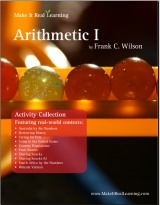
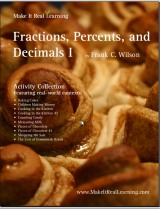
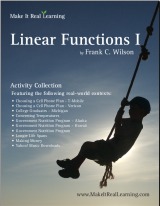
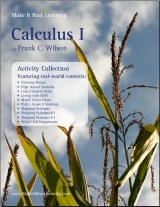
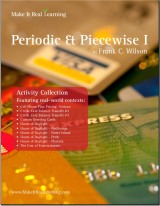
I have recently had the pleasure to add Make It Real Learning workbooks to my site. These books contain real-life math activities with real-life data, companies, and situations. They are written by Frank Wilson.
You can get a feel for these activities by downloading a FREE activity sampler (a PDF file) that contains 10 sample activities from Make It Real Learning product line.
Some examples of the topics included in these activities are: cell phone plans, autism, population growth, cooking, borrowing money, credit cards, life spans, population growth, and music downloads. But there are many more, more than I can list here.
As students work through the problems, they can use the math skills and concepts they have learned in their math curriculum (such as the concept of average or graphing), and apply those to a situation from real life.
Each activity-lesson in the book contains several questions about the situation, starting with basics and going into more in-depth evaluations, and should be adequate for one-two complete class periods.
Why does that benefit you, the teacher? It will motivate the students far more than dull, boring word problems from the textbook. It will show students how mathematics is truly USEFUL. Also:
- The problems are written by an experienced math teacher (Frank Wilson)
- The problems are matched to the learning objectives of the National Council of Teachers of Mathematics (NCTM). This means that the concepts and skills required to complete the problems ARE found in typical middle and high school mathematics curriculum. You can simply replace some of the problems in your textbook with these real-life scenarios.
- These activities are excellent to be used in a small-group setting.
- Typically, the activities contain challenging parts and therefore allow students to practice real problem solving - not just apply knowledge from textbook examples to other almost identical problems.
- Gifted students can enjoy the challenge of solving all the questions on their own.
All books include complete solutions to all activities and problems. Please note that Make It Real Learning workbooks do not contain the instruction or explanations of the concepts.
A list of available books:
Arithmetic I - for grades 3-6
Fractions, Percents, and Decimals I - for grades 4-8
Fractions, Percents, and Decimals II - for grades 6-11
Sets, Probability, and Statistics I - for grades 6-10
Linear Functions I - for algebra 1 and algebra 2
Linear Functions II - for algebra 1 and algebra 2
Quadratic Functions I - for algebra 1 and algebra 2/precalculus
Exponential and Logarithmic Functions I - for algebra 2/precalculus
Periodic and Piecewise Functions I - for algebra 2/precalculus
Polynomial, Power, Logistic, and Rational Functions I - for algebra 2/precalculus
Calculus I - for grade 12
You can get ALL 11 workbooks together for a discounted price of $39.99.
3. Division of fractions conceptually
I've managed to make another video on a very important topic (I feel) of fraction division. I apologize for the audio; I do want to improve and we will definitely work on that to get it better next time.

Division of Fractions Taught Conceptually, part 1

Division of Fractions Taught Conceptually, part 2
The video shows a step-by-step approach for teaching division of fractions conceptually:
- Start with sharing divisions that divide evenly. For example, 4/7 ÷ 2 can be thought of as "Two people share 4/7 of a pie evenly. How much of the pie does each person get?"
Children can figure these out mentally without using any rule.
- Continue to measurement divisions where we think, "How many times does the divisor fit into the dividend?". Again, the problems should first be designed so that the divisions are even. For example, 4 ÷ (1/2) means "How many times does 1/2 fit into 4?" Or, 3 1/5 ÷ 2/5 means "How many times does 2/5 fit into 3 1/5?" Again, no rule is necessary to solve these - just logical thinking.
- Next, study measurement divisions with the dividend of one. This leads to the concept of reciprocal numbers. For example, 1 ÷ 3/4 is thought of as "How many times does 3/4 fit into 1?" As I show in the video, and you should show visually, 3/4 fits into 3/4 once, and into the leftover piece of 1/4 it fits 1/3 of the way. So, all total 3/4 fits into 1 exactly 1 1/3 times.
Students should do a sufficient number of these kinds of problems so that they get familiar with the thinking process. After that, take some of the problems they have solved, and write the answers as fractions instead of mixed numbers. For example we found above that 1 ÷ 3/4 = 1 1/3. Write 1 1/3 as a fraction, and you get 1 ÷ 3/4 = 4/3. Now, 3/4 and 4/3 are reciprocal numbers. If you multiply them, you get 1. And this happens with every such division problem.
- Lastly, we apply this neat pattern with reciprocal numbers to arbitrary fraction division problems, and thus arrive at the shortcut for fraction division.
For example, 7 ÷ (4/5). Use the helping problem of 1 ÷ (4/5) = 5/4. Since 4/5 fits into 1 exactly 5/4 times, it fits into 7 exactly seven times that many times, or 7 × 5/4 = 8 3/4 times. Similarly, let's consider 6/7 ÷ (3/4). First look at the helping problem 1 ÷ (3/4) = 4/3. Since 3/4 fits into 1 exactly 4/3 times, it fits into 6/7 exactly 6/7 that many times. The answer is therefore 6/7 × 4/3 = 24/21 = 1 1/7.
We can notice that for any fraction division problem, we end up multiplying the dividend by the reciprocal of the divisor! And students can actually notice and understand this on their own, using this method.
4. Elementary math & reasoning skills
Someone recently sent me a VERY interesting link:
The Story of an Experiment
http://www.ithaca.edu/compass/storyI-III.htm
This experiment in math teaching was done in the 1930s by by L. P. Benezet, and the main gist of it was that formal arithmetic studies were delayed until the latter half of 6th grade. Instead, the instruction concentrated on "teaching the children to read, to reason, and to recite - my new Three R's."
They also were taught about numbers they encountered in their reading materials, about time, about measuring units, estimation, and coins. Finally in 5th and 6th grade they also learn skip-counting. Formal arithmetic, meaning paper-and pencil work with addition, subtraction, multiplication, and division using a textbook began in latter half of 6th grade and continued till 8th grade.
The experiment was a huge success. Mr. Benezet compared the children's abilities in the experimental classroom to those of the traditional classrooms, and every time the "experimental" children were able to reason out word problems correctly, whereas those taught traditionally just stumbled all around, trying to find some formula to use.
Read my comments about this story.
5. Tidbits
Till next time,
Maria Miller
Miss something from the earlier volumes? See newsletter archives.
Feel free to forward this issue to a friend. Subscribe here.
|