
Hello again and welcome to October! |
1. Math Mammoth NewsI will run a short flash sale later in October. Right now, Homeschool Buyers Club is running a sale for the large Math Mammoth bundles (40% off). |
2. Meaning of factors in multiplication: four groups of 2, or 4 taken two times?Someone asked me about the interpretation or meaning of the two numbers in multiplication, such as 4 × 2. Do you view it as four groups of 2, OR as four, taken two times?Here's their question: "...I noticed that your explanation about how to interpret a math phrase, such as 4 × 2, is different from how I have understood it and taught it to my older daughter who was using RightStart Math at this level. Here's my response. I'll try to briefly explain the main reason for teaching multiplication that way. It is because then it becomes easier to tie the concept of multiplication in with OTHER CONCEPTS coming up in the next grades. Later, students will study multiplication with fractions and decimals, and ultimately with percentages. When we transition to fractions, we see calculations such as 1/2 × 7. I teach students to think of it as "half of seven", in essence "translating" the multiplication sign into "of". It matches the notion of 5 × 7 meaning five groups of seven. Then when we get to decimals and, most importantly, percentages, we will have 0.3 × 50 which is the same as 30% × 50, or 30% of 50. Notice the word "of" once again. In other words, 30% of 50 is equal to 0.3 × 50. This last idea is of paramount importance for students in algebra, so that they can write algebraic equations for problems involving percentages... for example, to solve for the initial or final price when a discount percentage is known. One quick example of the above... A gadget was discounted by 45% and now its price is $67.38. What was the original price? We can write the equation 0.55p = 67.38 and solve it in a snap. The expression 0.55p means 55% OF the original price. So that is why, in 3rd grade, I teach children to view 5 × 7 as five groups OF seven instead of five, taken seven times. I'm trying to make it easier for them to understand (1) fraction multiplication, (2) percentages, and (3) algebra. Hope this helps! |
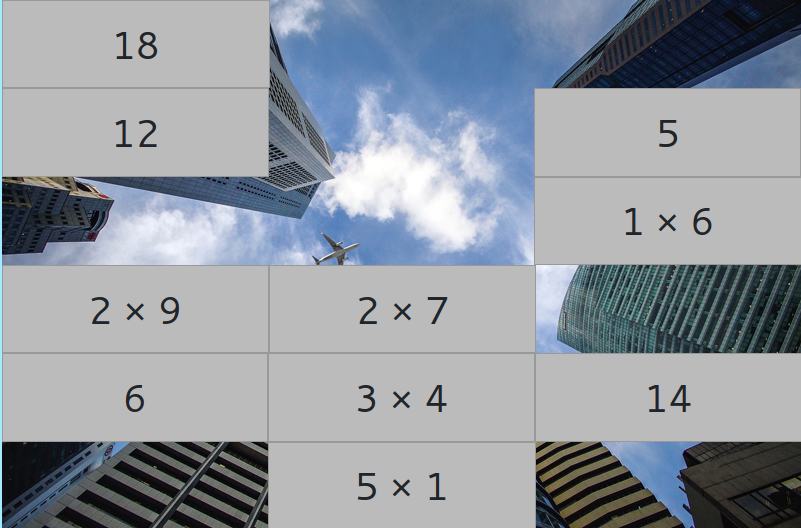
3. Multiplication tablesI know, I keep repeating this info, but it's because there are many new subscribers and because this is such a foundational topic.If a child does not learn the times tables by heart, it hinders them a lot. There are so many other math topics that rely on multiplication: division, long division, finding factors, prime factorization, practically ALL fraction operations, decimal multiplication and division, and many topics in algebra. Granted, some children with learning difficulties cannot learn them, and if that happens to be the case with yours, then at some point it will be more beneficial to move one with math topics, and give them a chart or a calculator. For the rest, here are several resources:
 |
4. Free Math Contest for Grades JK–8 — October 6 & 7 Well, I don't know! 😀 Some children enjoy such, and others do not. But here is your chance to try such for free. North Star Contests is kicking off their 2026–27 season with a completely free opening round — no code needed, no commitment required. Round 1 runs from 8:00 AM Eastern on Tuesday, October 6 to 8:00 PM Eastern on Wednesday, October 7. Students can write anytime within that window, from home, in one sitting — whenever works best for your family. There's a separate paper for each grade from JK through Grade 8. Every participant receives a certificate, and results arrive about two hours after the window closes, with full answer keys unlocking after October 7. Already have a North Star account from the January contest or the Summer Math Challenge? No need to register again — just log in and your child is ready to go. New to North Star? Register anytime at northstartests.com — right up until the contest itself. It's the first of six rounds this season. Round 1 is free with no obligation for the rest. A great low-pressure way to try competitive math! |
5. Online practice tool for telling time / elapsed timeHere's a neat interactive tool for practicing telling time AND elapsed time: https://clockabc.dokubasis.de/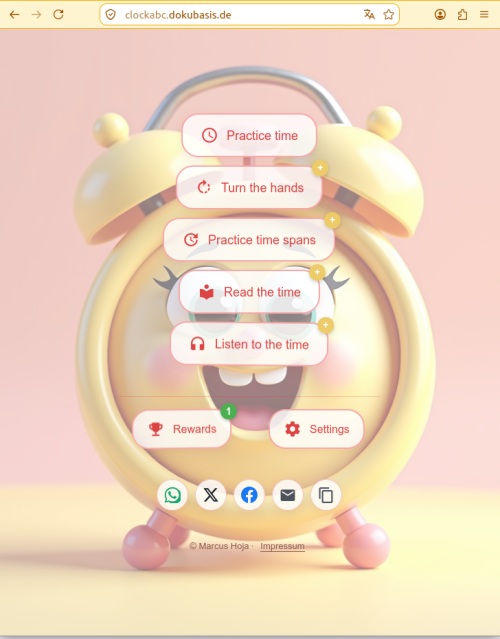 The options include
https://clockabc.dokubasis.de/ We also have telling time and elapsed time online practice at the Math Mammoth website. |
6. Free algebra textbooks (online)I've known about One Mathematical Cat for several years now. That site is still offering an entire ALGEBRA 1 curriculum with interactive online exercises for free!The author, Dr. Carol JVF Burns, also offers an offline version of the entire course for a free download. 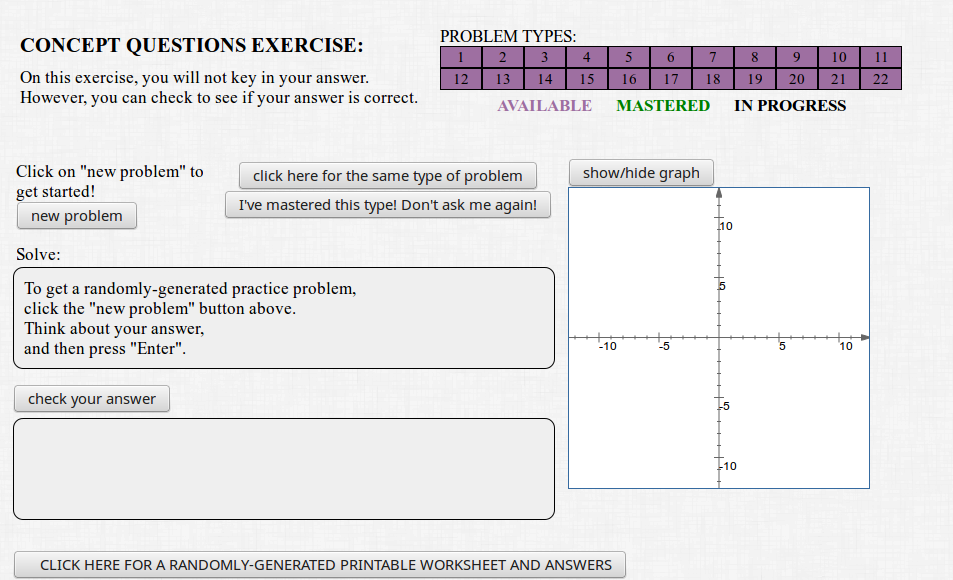 Another algebra 1 online text, complete with exercises, is CK-12's interactive Algebra 1. |
7. Just for fun!Thanks for reading! 🙂 Feel free to forward this issue to a friend/colleague! Subscribe here. Till next time, Maria Miller |
| Complete curriculum | Math games and interactive practice | Math Mammoth freebies | New to MM? Start here |
| Privacy & your personal data | The Wedding Garment Parable | Blue Series: For filling in gaps |