
Hello again! I hope everyone (on the Northern hemisphere) is staying warm! I've been feeling plenty chilly this month so far. |
1. Math Mammoth newsNot a whole lot to report... we're working on both grade 1 (new edition) and Kindergarten to have them published later this year. The next sale for MM digital products will be in mid-March.
I just purchased Addition and Subtraction 2C and my son who was struggling with borrowing in subtraction is already catching on so well. He did page 19 where you explain breaking apart 10s and then asked me to reprint it so he can do it again (twice!). The Dark Blue series is truly a Godsend for anyone struggling with a specific subject but not wanting to switch to a whole new curriculum. My budget is very limited and I really appreciate you for providing this series at such a reasonable cost.
With gratitude, Katie |
2. Printed books and ISBN numbersDid you know? You can ask any bookstore to order Math Mammoth printed books from Ingram, the world's largest wholesale book distributor. All you need is to give them the ISBN number(s) of the title(s) you want.We provide a spreadsheet listing all of the ISBN numbers on this page. I also recommend using the ISBN number when you search for Math Mammoth books on Amazon. That is because if you just search with the title, you might accidentally purchase the black-and-white version if you're not careful. Amazon tends to place those higher in the search than the color versions. (That is because the bw ones are printed by KDP which is an Amazon company, whereas the color books are printed by Lightning Source.) |
3. Do MM pages feel overwhelmingly busy to your child?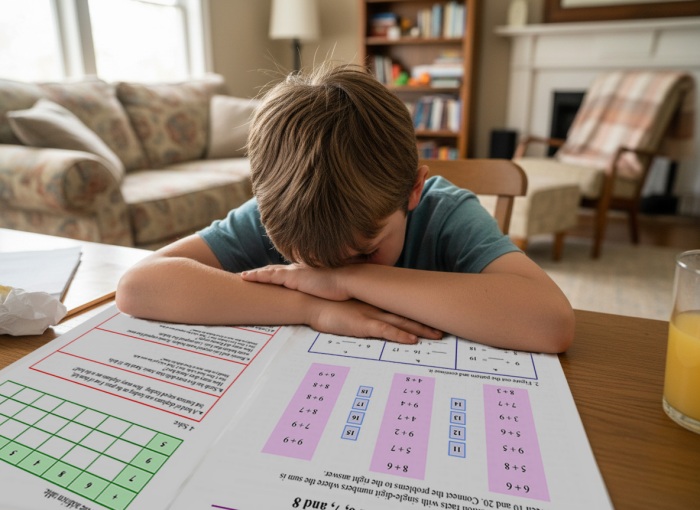
Here are some highlights:
Back to me... BTW, not sure if anyone has thought of the fact that if there were, say, only 1/2 of the problems per page than what there is now, the price of each book would be quite a bit higher. Page count is a major factor in determining the printing cost. Right now that cost is close to 5 cents a page (color printing at Lightning Source). Plus there is a fixed fee on top of that, plus the bookstore selling it has to get its share. Pricing of print books is kind of interesting... for example, if the printing cost was, say, $10, then the retail price has to be set to more than $22.22... because bookstores prefer to buy at a 55% discount from the set retail price. The math goes like this. Say right now the book is 200 pages and the printing cost is $11.68. => the retail has to be set at least to $25.95. (That $25.95 would be with no compensation to the author.) Make the book 380 pages instead by spreading the problems out... then the print cost is $20.63 and the retail at a minimum is $45.85. That would be a $19.90 increase, or a 77% increase in retail price (and these calculations are omitting any author compensation.) That said, what bookstores do is they then advertise the book at 10-20% off of retail to make it look good. So the retail price set at the printing company does not end up being quite what the consumer pays. Then someone suggested that the worktext could have only half of the problems, spread out more, and then the other half would be in a separate workbook (like in Singapore Math). I'll consider the idea, but probably it will be impossible to please everyone in this matter... whichever way things go, some people will be happy and others will not. (We do already offer skills review workbooks that provide YET additional review problems.) |
4. Make an Equation at MM Practice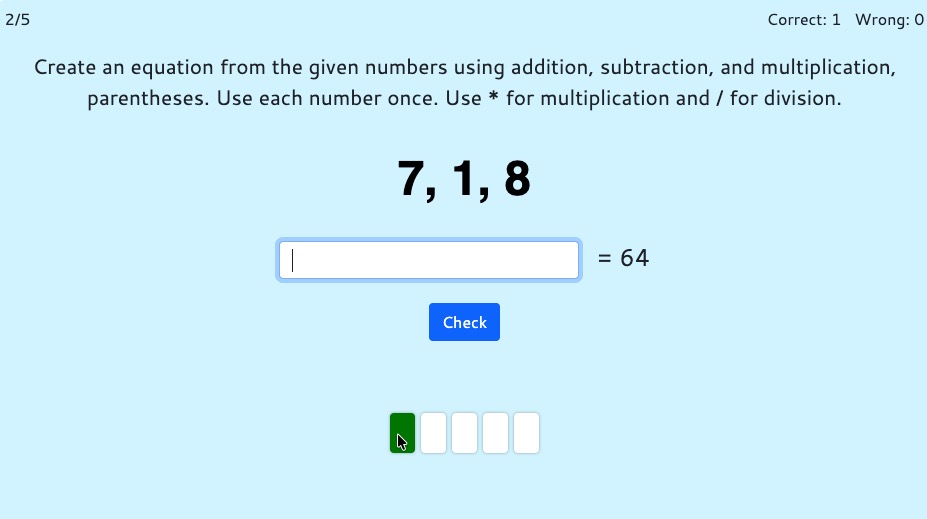 This online activity practices the order of operations and logical thinking. You are given several numbers and a target number. Your task is to make the target number using your chosen math operations and the given numbers. Remember to use the correct order of operations! You can choose what type of numbers get used, the operations to use, the number of numbers, and the number of problems. For example, for third grade, to practice addition and subtraction, choose only addition and subtraction, single-digit, two-digit, and three-digit numbers, and a maximum of three numbers to use. (Here is a quick link for those exact options.) For fourth grade, one idea is to choose single-digit numbers and multiples of ten, and addition/subtraction/multiplication. Here is a quick link for that. Experiment with the options as you like! Make an Equation |
5. Are your students thinking in your math class? I mean REALLY thinking?I found a really good post on Facebook and I shared it on my FB page.I hope that even those of you without a FB login can see it. Shelley Gray gives five examples of changing math problems from the usual "calculate this" into a version that requires thinking, and truly checks if they have understood the concept. 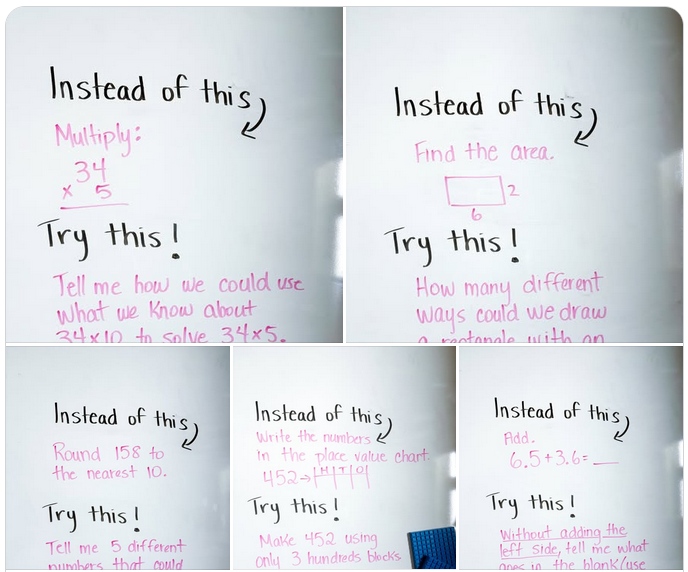 QUOTE |
6. Just for fun!
Thanks for reading! 🙂 Feel free to forward this issue to a friend/colleague! Subscribe here. Till next time, Maria Miller |
| Complete curriculum | Math games and interactive practice | Math Mammoth freebies | New to MM? Start here |
| Privacy & your personal data | Our Earth Without Form | Blue Series: For filling in gaps |