Homeschool Math Newsletter, Vol. 16
February 2008
Hello again! This is Maria Miller from HomeschoolMath.net and MathMammoth.com.
This month's newsletter has some REALLY interesting tidbits. I also want to talk about problem solving some more, this time in the form of examples, and about making your own math dictionary. I also have some new Math Mammoth books available in the Blue Series.
In this month's newsletter:
1. New Math Mammoth books: Multiplication 2, Division 2, Place Value 4
2. Problem solving example: clock face problem
3. Problem solving example: plus sign problem
4. Problem solving example: wider-shorter table problem
5. Should you use a math dictionary?
6. Tidbits
New Math Mammoth books: Multiplication 2, Division 2, Place Value 4
Some recent additions to Math Mammoth Blue Series books:
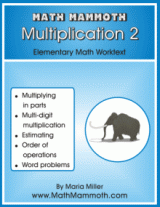 Math Mammoth Multiplication 2
This book concentrates on multi-digit multiplication, first explaining what it is based on (multiplying in parts), then practicing the algorithm. also included: order of operations, multiplying with money, and lots of word problems.
Download sample pages (choose "save"):
Contents & Introduction
Multiply by Whole Tens and Hundreds
Multiply in Parts
Multiplying in Columns, Standard Way
Error of Estimation
Order of Operations
Money and Change
Multiplying 3-digit by 2-digit
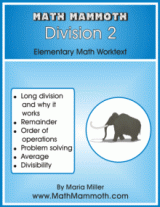 Math Mammoth Division 2 Math Mammoth Division 2
This book includes lessons on division, long division, the remainder, part problems, average, and problem solving.
Download sample pages (choose "save"):
Contents and Introduction
Division Terms, Zero and One
Finding Parts with Division
Long Division 1
Long Division with 4-Digit Numbers
Average
Divisibility Rules
NOTE: Multiplication 2 and Division 2 now replace the earlier book called Multiplication Division 2.
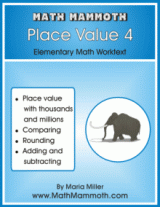 Math Mammoth Place Value 4 Math Mammoth Place Value 4
In this book, the focus is on place value with
thousands, ten thousands, and hundred thousands. We also study numbers with millions a little. The book is most suitable for third or fourth grade.
Download sample pages (choose "save"):
Contents
Thousands
Rounding
Estimating
A Little Bit of Millions
2. Problem solving example: clock face problem
This is a 5th grade problem, taken from a very nice collection of word problems for kids by Canada's SchoolNet.
I'd like to use them to illustrate problem solving. But before you click to see the solution, please try to solve it yourself.
Divide the face of the clock into three parts with two lines so that the sum of the numbers in the three parts are equal.
Read the solution and discussion here.
3. Problem solving example: plus sign problem
How many addition signs should be put between digits of the number 987654321 and where should we put them to get a total of 99?
Again a 5th grade problem. Try to solve it or give it to your kids first. Then, read the solution and discussion here.
4. Problem solving example: shorter-wider table problem
A rectangular kitchen table is three times as long as it is wide.
If it were 3 m shorter and 3 m wider it would be a square.
What are the dimensions of the rectangular table?
This is for 6th grade. Try to solve it or give it to your kids first. Then, read the solution and discussion here.
5. Should you use a math dictionary?
When it comes to what is fashionable in homeschooling, these days lap books, notebooking, lapbooking, whatever term you use, are definitely "in". I haven't seen much anything for math, though. And no, I haven't made any lapbooks either! But I do have an idea for one:
Let your child/student make their own math dictionary! Just make a new page in it every time there is a new concept or term to study. The student can write the term, write an explanation, an example calculation, or draw a picture of it − or all of those.
Continue reading about math dictionaries / glossaries.
6. Tidbits
- The World Math Day Challenge is coming up in early March. Children all across the globe play mental math games against each other. This is totally free to participate in.
- Blogged.com directory
recently rated a bunch of math blogs; mine ended up in top ten.
- Classic Math Mistakes - Gallery of Posters. This is really cool - a collection of classic math mistakes, presented as posters with silly titles. You can post them on your wall and let students figure them out, because the poster doesn't actually explain the mistake; it just shows an example of it and the funny title.
- Multiplication algorithm poll at MathNotations. This interesting poll asks about which multiplication algorithm should be taught in grades 3-5 for multidigit multiplication, and if mastery should be required. If you're interested in that issue, go check it out and vote.
Till next time,
Maria Miller
|