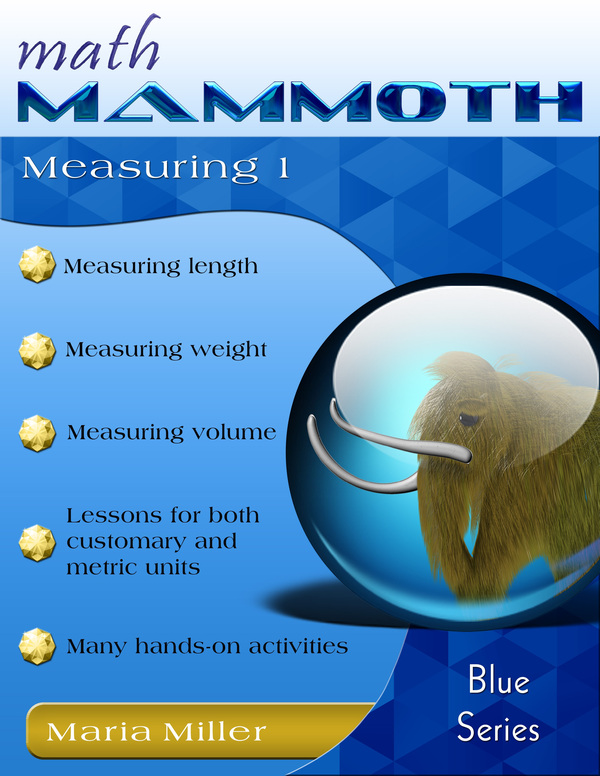
Math Mammoth Measuring 1
75 pages
(includes answers)
Prices & ordering
PDF download USD $5.70
You will be purchasing the downloads from my authorized reseller Comecero.
Printed copy $9.85
 Este libro en español
Math Mammoth Measuring 1 is a worktext that covers measurement-related topics over the span of three grade levels (grades 1-3; ages 6-9 years). Being a worktext, it contains both explanations of the concepts (the “text”) and exercises (the “work”). The lessons cover measuring length, weight and volume using the most common metric and customary units, and some easy conversions between the units.
In general, the lessons require very little teacher preparation; however in several you will need to have on hand common measuring tools, such as a ruler, a scale or measuring cups.
This book is not organized by grade levels. Instead, the lessons are grouped by topic. The first part of the book (up to the lesson Review 1) deals with measuring length, in increasing difficulty. The very first lessons deal with the concept of measuring length. Children use paperclips and other improvised units to measure the length of objects. The following lessons bring in whole inches and centimeters, and teach students how to measure the length of objects using a ruler and a measuring tape. Then there are lessons that also include feet, yards, miles, meters, and kilometers.
Then follow four lessons about weight (mass). In these lessons, students use a bathroom scale and a kitchen scale to weigh objects both in metric and customary units. Then the book also has two lessons about volume (one for metric, one for customary units), which include many hands-on activities.
When it comes to measuring, experience is the best teacher. We all use various measurement units in our everyday life, and using them is the key to remembering what they are and how to convert between them. The units your student is not using are likely to be forgotten easily. So encourage your student to have free “play time” with measuring devices such as scales, measuring cups, measuring tapes and rulers.
Math Mammoth also has another worktext about measuring, Math Mammoth Measuring 2, which is a sequel to this one. In it, students practice measurement unit conversions and problem solving.
Manipulatives
Here is a list of manipulatives that are needed or recommended for Math Mammoth Measuring 1. Children learn measuring much better if they can "get their hands on it", so the book contains lots of activities for actually measuring items.
- A ruler that measures in inches.
- A ruler that measures in centimeters.
- A measuring tape that measures in feet.
- A measuring tape that measures in meters.
- A bathroom scales. It is best if you can have one that measures in pounds and kilograms, or one with pounds and another with kilograms; however I realize most people wouldn't normally buy two bathroom scales, so if you decide not to get both kinds, it means you will just need to skip some activities in the measuring chapter.
- A kitchen scales that measures in ounces.
- A kitchen scales that measures in grams.
- A quart jar and a pint jar.
- Measuring cups that measure 1 cup, 1/2 cup, 1/4 cup of which at least one has markings for ounces.
- A measuring cup that measures in milliliters.
The PDF version of this book can be filled in on a computer, phone, or tablet, using the annotation tools found in many PDF apps. See more.
Better Yet - Bundle Deals!
Blue Series - $165 (download)Blue Series for grades 1-3 - $49 (download)
Blue Series for grades 4-5 - $47 (download)
Blue Series for grades 6-8 - $69 (download)
Light Blue Series, grades 1-8 - $225 (download)
Light Blue Series, grades 1-4 - $112.50 (download)
Light Blue Series, grades 5-8 - $112.50 (download)
All Inclusive Bundle - $275 (download)
"Everything" Bundle - $330 (download)
Learn more about the bundles!
*BONUS*: Buy any bundle listed above, and get the fully upgraded Soft-Pak software for FREE (includes 4 math and 2 language arts programs, complete with on screen and printable options).
How and where to order
You can buy Math Mammoth books at:
- Here at MathMammoth.com website — simply use the "Add to cart" buttons you see on the product pages.
- Rainbow Resource carries printed copies for the Light Blue series books.
- Homeschool Buyers Club offers download versions of the Light Blue series, plus the Blue series bundle.
- Homeschool Planet sells the digital versions of the main curriculum and lesson plans to go with them.
- K5 Learning offers download versions of the Blue series.
- TPT sells the Light Blue Series downloads, plus topical units.
- Lulu sells printed copies for most of the Math Mammoth materials (various series).
By purchasing any of the books, permission IS granted for the teacher (or parent) to reproduce this material to be used with his/her students in a teaching situation; not for commercial resale. However, you are not permitted to share the material with another teacher.
In other words, you are permitted to make copies for the students/children you are teaching, but not for other teachers' usage.
Math Mammoth books are PDF files. I recommend you use Adobe Reader to view them, including if you use a Mac. You can try other PDF viewers, but they may at times either omit or mess up some of the images.
Receive my monthly collection of math tips & resources directly in your inbox — and get a FREE Math Mammoth book!

You can unsubscribe at any time.
Math Mammoth TourConfused about the different options? Take a virtual email tour around Math Mammoth! You'll receive: An initial email to download your GIFT of over 400 free worksheets and sample pages from my books. Six other "TOURSTOP" emails that explain the important things and commonly asked questions concerning Math Mammoth curriculum. (Find out the differences between all these different-colored series!)This way, you'll have time to digest the information over one or two weeks, plus an opportunity to ask me personally about the curriculum. A monthly collection of math teaching tips & Math Mammoth updates (unsubscribe any time) We respect your email privacy.
Note: You will FIRST get an email that asks you to confirm your email address. If you cannot find this confirmation email, please check your SPAM/JUNK folder. |
"Mini" Math Teaching CourseThis is a little "virtual" 2-week course, where you will receive emails on important topics on teaching math, including:
- How to help a student who is behind You will also receive: A GIFT of over 400 free worksheets and sample pages from my books right in the very beginning. A monthly collection of math teaching tips & Math Mammoth updates (unsubscribe any time)
We respect your email privacy.
Note: You will FIRST get an email that asks you to confirm your email address. If you cannot find this confirmation email, please check your SPAM/JUNK folder. |
Maria's Math TipsEnter your email to receive math teaching tips, resources, Math Mammoth news & sales, humor, and more! I tend to send out these tips about once monthly, near the beginning of the month, but occasionally you may hear from me twice per month (and sometimes less often). Peek at the previous tips here. You will also receive:
We respect your email privacy.
|
|