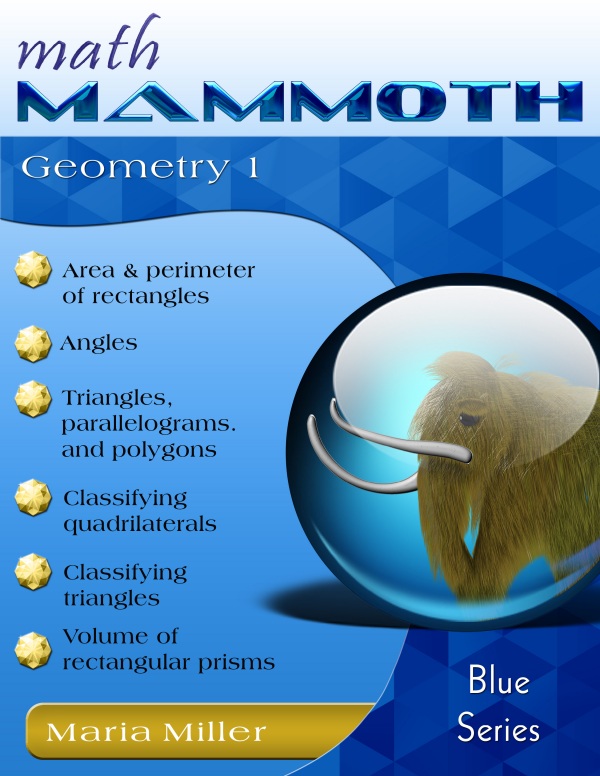
Math Mammoth Geometry 1
117 pages
(includes answers)
Sample pages (PDF)
Contents
Review: Area of Rectangles
Measuring Angles
Triangles
Classifying Quadrilaterals 2
Volume
Prices & ordering
U.S. version
PDF download USD $9.10
International version
(all metric; A4 paper size)
PDF download USD $9.00
You will be purchasing the downloads from my authorized reseller Comecero.
Printed copy
 Este libro en español
Math Mammoth Geometry 1 covers all the typical geometry topics for grades 4-5: angles, triangles, quadrilaterals, other polygons, area, perimeter and volume.
The book starts out by reviewing the third grade concepts of area and the perimeter of rectangles. Students also apply these concepts in various problems, including problems where they write simple equations and a problem where they explore all possible perimeters for a given area.
The first part of the book covers 4th grade topics, with a focus on angles. Students learn about lines, rays, and angles; and about acute, right, obtuse, and straight angles. They learn how to measure and draw angles with a protractor. We also study angle problems where students write simple equations. The lesson Estimating Angles has an optional section on turning in an angle, which can be challenging, so feel free to omit it if you wish.
The lesson Parallel and Perpendicular Lines also ties in with the topic of angles, because two lines are perpendicular if they form a right angle. After that, we study parallelograms and other quadrilaterals in more detail, paying attention to their angles and lengths of sides.
We also study triangles and classify them according to their angles (acute, obtuse, or right triangles). The last (and easy) topic in the first part of the book is line symmetry.
The latter half of the book covers 5th grade topics, starting with the lesson Review: Angles. The focus of this portion is on two topics: classifying two-dimensional shapes, and volume.
The lesson Polygons covers the concept of a polygon and the names of several common ones. Students classify figures into polygons and non-polygons, and also into regular polygons versus non-regular polygons.
The next topic is classifying quadrilaterals. The focus is on understanding the classification, and understanding that attributes defining a certain quadrilateral also belong to all the “children” (subcategories) of that type of quadrilateral. For example, squares are also rhombi, because they have four congruent sides (the defining attribute of a rhombus).
A possible confusion point is the definition of a trapezoid. There exist two possible definitions:
- (Exclusive definition:) A trapezoid has exactly one pair of parallel sides.
- (Inclusive definition:) A trapezoid has at least one pair of parallel sides.
Both definitions are legitimate, but lead to different analysis when classifying quadrilaterals. Under the exclusive definition, a parallelogram is not a trapezoid, but under the inclusive definition, it is. Most college-bound textbooks favor the inclusive definition, and that is what is used in this text, also.
Then we study the classification of triangles. Students are now able to classify triangles both in terms of their sides and also in terms of their angles.
The second focus topic of this latter half is volume. Students learn that a cube with the side length of 1 unit, called a “unit cube,” is said to have “one cubic unit” of volume, and can be used to measure volume. They find the volume of right rectangular prisms by “packing” them with unit cubes and by using formulas. They recognize volume as additive and solve both geometric and real-word problems involving volume.
The book includes three optional lessons listed in the end: area and perimeter problems, star polygons, and circles. Use them as time allows. The lesson on area and perimeter can be important for those students who tend to forget these concepts. The lesson on star polygons is intended as a fun artistic topic. The lesson on circles involves the usage of a compass, which may be hard for some children at this age. Those who can master it will probably find the exercises involving multiple circles fascinating.
Geometry is a hands-on subject, and thus the lessons include quite a few drawing exercises which can be done on blank paper, in a notebook, or in the worktext (for most). I hope the students enjoy the hands-on experience. Besides, these drawing exercises are a good means of achieving a true conceptual understanding of geometry concepts.
Geometry is full of strange-sounding words. I suggest that student(s) keep a geometry notebook, where they draw picture(s) and text to explain every new concept or term. This will help them to remember those terms. They can also do the drawing exercises in the notebook. Encourage the students to be creative so that the notebook becomes their own special work. You can even give them credit for it.
Please see also the videos at https://www.mathmammoth.com/videos/geometry_1. Most of them match the topics in this book, and can be used to provide additional instruction.
The PDF version of this book can be filled in on a computer, phone, or tablet, using the annotation tools found in many PDF apps. See more.
Feedback
Susan Medendorp
I used, and continue to use your Geometry 1 workbook as my main geometry curriculum. I use Math Advantage as a basis for my math lessons but skip around and supplement it greatly.
My son enjoys the Geometry workbook. I appreciate that you have included area, perimeter and volume in the book. Many books categorize those topics as measurement, but I've found that it is easier to teach them with geometry. The curriculum is more in depth than most for the recommended grade level.
Tracy Thompson
This book is quite good for building fundamental knowledge for children who are learning geometry. This is more than enough, comparing mine when in same grade 30 years ago.
Regards,
Slamet Suryanto
My students enjoyed the review!
Prudence Jencka
See also the review by Sol Lederman.
Better Yet - Bundle Deals!
Blue Series - $180 (download)Blue Series for grades 1-3 - $59 (download)
Blue Series for grades 4-5 - $49 (download)
Blue Series for grades 6-8 - $72 (download)
Light Blue Series, grades 1-8 - $225 (download)
Light Blue Series, grades 1-4 - $112.50 (download)
Light Blue Series, grades 5-8 - $112.50 (download)
All Inclusive Bundle - $275 (download)
"Everything" Bundle - $330 (download)
Learn more about the bundles!
*BONUS*: Buy any bundle listed above, and get the fully upgraded Soft-Pak software for FREE (includes 4 math and 2 language arts programs, complete with on screen and printable options).
How and where to order
You can buy Math Mammoth books at:
- Here at MathMammoth.com website — simply use the "Add to cart" buttons you see on the product pages.
- Rainbow Resource carries printed copies for the Light Blue series books.
- Homeschool Buyers Club offers download versions of the Light Blue series, plus the Blue series bundle.
- Homeschool Planet sells the digital versions of the main curriculum and lesson plans to go with them.
- K5 Learning offers download versions of the Blue series.
- TPT sells the Light Blue Series downloads, plus topical units.
- Lulu sells printed copies for most of the Math Mammoth materials (various series).
By purchasing any of the books, permission IS granted for the teacher (or parent) to reproduce this material to be used with his/her students in a teaching situation; not for commercial resale. However, you are not permitted to share the material with another teacher.
In other words, you are permitted to make copies for the students/children you are teaching, but not for other teachers' usage.
Math Mammoth books are PDF files. I recommend you use Adobe Reader to view them, including if you use a Mac. You can try other PDF viewers, but they may at times either omit or mess up some of the images.
Receive my monthly collection of math tips & resources directly in your inbox — and get a FREE Math Mammoth book!

You can unsubscribe at any time.
Math Mammoth TourConfused about the different options? Take a virtual email tour around Math Mammoth! You'll receive: An initial email to download your GIFT of over 400 free worksheets and sample pages from my books. Six other "TOURSTOP" emails that explain the important things and commonly asked questions concerning Math Mammoth curriculum. (Find out the differences between all these different-colored series!)This way, you'll have time to digest the information over one or two weeks, plus an opportunity to ask me personally about the curriculum. A monthly collection of math teaching tips & Math Mammoth updates (unsubscribe any time) We respect your email privacy.
Note: You will FIRST get an email that asks you to confirm your email address. If you cannot find this confirmation email, please check your SPAM/JUNK folder. |
"Mini" Math Teaching CourseThis is a little "virtual" 2-week course, where you will receive emails on important topics on teaching math, including:
- How to help a student who is behind You will also receive: A GIFT of over 400 free worksheets and sample pages from my books right in the very beginning. A monthly collection of math teaching tips & Math Mammoth updates (unsubscribe any time)
We respect your email privacy.
Note: You will FIRST get an email that asks you to confirm your email address. If you cannot find this confirmation email, please check your SPAM/JUNK folder. |
Maria's Math TipsEnter your email to receive math teaching tips, resources, Math Mammoth news & sales, humor, and more! I tend to send out these tips about once monthly, near the beginning of the month, but occasionally you may hear from me twice per month (and sometimes less often). Peek at the previous tips here. You will also receive:
We respect your email privacy.
|
|