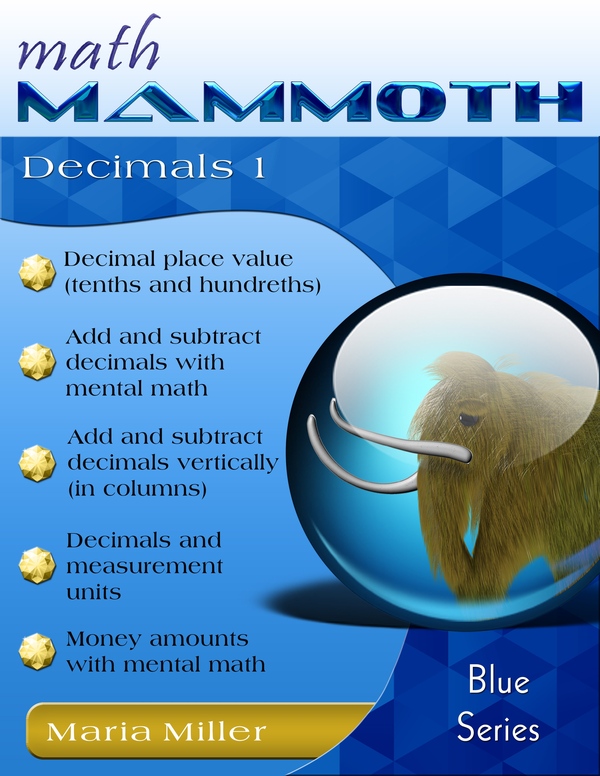
Math Mammoth Decimals 1
45 pages
(answers included)
Sample pages (PDF)
Contents and Introduction
Two Decimal Digits: Hundredths
Decimals & Measuring Units
Using Mental Math with Money
Prices & ordering
PDF download USD $2.20
You will be purchasing the downloads from my authorized reseller Comecero.
Printed copy $8.10
 Este libro en español
Math Mammoth Decimals 1 is is a worktext about decimal numbers for approximately 3rd and 4th grade levels. Being a worktext, it includes both the instruction and the exercises, all written directly to the student.
This book deals with decimal numbers that have tenths and hundredths—numbers with a maximum of two decimal digits. We only deal with some of the basic operations: addition, subtraction, and multiplication by a whole number, with a strong emphasis on mental calculations. The idea is to lay a solid conceptual foundation so that the student does not succumb to rote memorization of rules and procedures without understanding.
Note: multiplication and division of decimals are not covered. Those are taught in Math Mammoth Decimals 2.
We start out with place value—first only with tenths, or numbers with one decimal digit, and in a later lesson with hundredths. The lessons use number lines, fraction models, and place value charts to teach decimal place value and comparing decimals.
Next, students add and subtract decimals, both in columns and using mental math. We compare decimal operations with corresponding fraction operations in order to show why they work.
A common student error is to add 0.4 + 0.8 = 0.12. Here, the student may be considering the decimal part of a number as a “separate whole number”, and try to apply whole number arithmetic within the decimal part. To help such a student, read the decimals as fractions and emphasize how fractions are added. Think: four tenths plus eight tenths equals twelve tenths, which is 1.2.
When we add decimals of different ”lengths“ (numbers with different amounts of decimal digits), such as 0.4 + 0.08, you can tag a zero to the end of 0.4 so the problem becomes 0.40 + 0.08. Now, both addends have hundredths, so the answer is simply 48 hundredths or 0.48. This is the same thing as converting the corresponding fractions (four tenths and eight hundredths) to have the same denominator (forty hundredths and eight hundredths).
As a real-life application, the book includes a lesson on using decimals with metric measurement units.
Lastly, while the focus of the book is on place value, addition, and subtraction, we also study some mental math techniques in the context of money. While the focus of the book is place value, addition, and subtraction, the book also covers some mental math techniques in the context of money. For example, to find 7 × $2.99, you can multiply 7 × $3 = $21, and then subtract seven cents, to get the total of $20.93.😁
The PDF version of this book can be filled in on a computer, phone, or tablet, using the annotation tools found in many PDF apps. See more.
- Math Mammoth Decimals 2—a worktext about decimal place value and all basic operations with decimals (grades 5-6).
- Math Mammoth Fractions & Decimals 3—a worktext for all fraction and decimal topics with large denominators and more decimal digits (grades 6-7).
- Make It Real Learning: Fractions, Percents, and Decimals I—an activity workbook with real-world data, focusing on situations that use fractions, percents, and unit conversion (grades 4-7).
- Make It Real Learning: Fractions, Percents, and Decimals II—an activity workbook with real-world data, focusing on situations that use decimals, ratios, histograms, and percents (grades 5-9).
My 5th grader and I worked through the decimals book. It actually helped me to understand decimals a lot better also. We were both amazed at how easy they are to work with once you understand the concepts behind them.
I love the books. They include a lot of thinking and reasoning skills that our other math program did not include. They also present things in a simple clear manner. No more tears when it comes to decimals!!!
Michele Cutlip
Better Yet - Bundle Deals!
Blue Series - $180 (download)Blue Series for grades 1-3 - $59 (download)
Blue Series for grades 4-5 - $49 (download)
Blue Series for grades 6-8 - $72 (download)
Light Blue Series, grades 1-8 - $225 (download)
Light Blue Series, grades 1-4 - $112.50 (download)
Light Blue Series, grades 5-8 - $112.50 (download)
All Inclusive Bundle - $275 (download)
"Everything" Bundle - $330 (download)
Learn more about the bundles!
*BONUS*: Buy any bundle listed above, and get the fully upgraded Soft-Pak software for FREE (includes 4 math and 2 language arts programs, complete with on screen and printable options).
How and where to order
You can buy Math Mammoth books at:
- Here at MathMammoth.com website — simply use the "Add to cart" buttons you see on the product pages.
- Rainbow Resource carries printed copies for the Light Blue series books.
- Homeschool Buyers Club offers download versions of the Light Blue series, plus the Blue series bundle.
- Homeschool Planet sells the digital versions of the main curriculum and lesson plans to go with them.
- K5 Learning offers download versions of the Blue series.
- TPT sells the Light Blue Series downloads, plus topical units.
- Lulu sells printed copies for most of the Math Mammoth materials (various series).
By purchasing any of the books, permission IS granted for the teacher (or parent) to reproduce this material to be used with his/her students in a teaching situation; not for commercial resale. However, you are not permitted to share the material with another teacher.
In other words, you are permitted to make copies for the students/children you are teaching, but not for other teachers' usage.
Math Mammoth books are PDF files. I recommend you use Adobe Reader to view them, including if you use a Mac. You can try other PDF viewers, but they may at times either omit or mess up some of the images.
Receive my monthly collection of math tips & resources directly in your inbox — and get a FREE Math Mammoth book!

You can unsubscribe at any time.
Math Mammoth TourConfused about the different options? Take a virtual email tour around Math Mammoth! You'll receive: An initial email to download your GIFT of over 400 free worksheets and sample pages from my books. Six other "TOURSTOP" emails that explain the important things and commonly asked questions concerning Math Mammoth curriculum. (Find out the differences between all these different-colored series!)This way, you'll have time to digest the information over one or two weeks, plus an opportunity to ask me personally about the curriculum. A monthly collection of math teaching tips & Math Mammoth updates (unsubscribe any time) We respect your email privacy.
Note: You will FIRST get an email that asks you to confirm your email address. If you cannot find this confirmation email, please check your SPAM/JUNK folder. |
"Mini" Math Teaching CourseThis is a little "virtual" 2-week course, where you will receive emails on important topics on teaching math, including:
- How to help a student who is behind You will also receive: A GIFT of over 400 free worksheets and sample pages from my books right in the very beginning. A monthly collection of math teaching tips & Math Mammoth updates (unsubscribe any time)
We respect your email privacy.
Note: You will FIRST get an email that asks you to confirm your email address. If you cannot find this confirmation email, please check your SPAM/JUNK folder. |
Maria's Math TipsEnter your email to receive math teaching tips, resources, Math Mammoth news & sales, humor, and more! I tend to send out these tips about once monthly, near the beginning of the month, but occasionally you may hear from me twice per month (and sometimes less often). Peek at the previous tips here. You will also receive:
We respect your email privacy.
|
|