Algebra 1 curriculum – recommendations for home schooling

This article lists some recommendations for an algebra 1 curriculum for home schooling – in particular for those of you who have used Math Mammoth during middle school years, and want to know where to continue after that.
(Please note: Math Mammoth users can go to an algebra 1 program directly after finishing Math Mammoth grade 7. If your student would benefit from a slower pace, I recommend Math Mammoth grade 8 first.)
In a nutshell, I recommend for most homeschooling parents to use a textbook along with some video instruction.
Why a textbook? Because it is good for students to learn to use a regular algebra textbook at this stage of their studies. It helps prepare them for any further studies (whether college or vocational) where they need to learn on their own, reading a textbook.
Also, good textbooks include not only basic exercises but also challenging ones. If you decide to go with some online algebra curriculum or video instruction, a regular textbook can act as a reference and as an additional problem "bank" for those challenging problems. You can also use it to check that your student is really getting instruction in all the typical algebra 1 topics.
Why videos? Because those replace the component that is present in regular classroom: a teacher explaining concepts and ideas. Learning algebra from a textbook alone might be too difficult for some students. If the parent cannot explain the math, videos will help bridge the gap. In today's world, there exist MANY free websites with algebra videos that can be used. And, some companies provide videos tailored to a specific textbook.
Jump to:
- Options for algebra 1 in a nutshell
- My recommendations
- Foerster's algebra
- What about algebra curriculum X?
- Free algebra resources
Options for algebra 1 course in a nutshell
- Use a regular textbook, along with video instruction or a class specifically tailored for that book. There exist several companies offering this; personally I like and recommend Math Without Borders (using Foerster's Algebra). Please see my review for more information.
- Use a regular textbook, along with videos from various math websites that may not be exactly tailored to the book. This is probably one of the most affordable options, because there exist so many sites offering free math videos.
- An algebra course from one of the large homeschooling curriculum companies. The drawback is that the authors of these products may not be math professors or even math teachers, and so the mathematics is often on a more "shallow" and superficial level than in textbooks authored by mathematics professors & teachers. Also, the explanations given for concepts may also be lacking in depth, and concentrate only on how to do the calculations, and not on the "why", or on the connections between concepts. Of course this varies from product to product, but I have seen some that judging from the samples were really "shallow".
However, I'm not saying these can't be used. If your student does not need a strong math background for future studies, they can be fine. Some families may also prefer the format, whether it be many workbooks, a computer-based curriculum, or some other format. - Enroll your child in a community college basic algebra course.
- Hire a tutor, either a tutor that visits your home or an online math tutor.
My recommendations
What follows are my recommendations and thoughts for high school math, and algebra 1 curriculum in particular, depending on your student's "comfort" level and your needs.
- Regular math students: I recommend Foerster's Algebra 1 along with the home study companion (videos) from Math Without Borders as an algebra program that is similar to "Math Mammoth style": rigorous and user-friendly, with plenty of practice problems, including some challenges. See my review.
- Very strong math students: If your student is geared towards math competitions and excels and thrives with challenging problems, check out the textbooks and courses at Art of Problem Solving. Their Introduction to Algebra textbook is structured to inspire the reader to explore and develop new ideas. Each section starts with problems, giving the student a chance to solve them without help before proceeding. The text then includes solutions to these problems, through which algebraic techniques are taught.
- If your student is struggling, and/or you'd like to use an option that is completely online, I suggest Unlock Math. Unlock Math courses are based on engaging video instruction and interactive exercises. The courses are comprehensive and quite step-by-step. However, it doesn't have many word problems, and some that it has are quite easy, in my opinion. The algebra course includes one challenging problem per lesson, which is a good thing; I just wish it had more of those!
There exist other courses that are similar; I just really liked Unlock Math overall when I had an opportunity to check it out. The main drawback is, like I said, the relative lack of word problems and challenging problems.
Foerster's Algebra 1
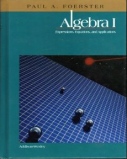
With Foerster, you can definitely "hear" a teacher speaking to you through the text. The book is written to the student, with excellent, sometimes even pedantic, explanations. The text often includes little tips like what a classroom teacher might say, such as "the vinculum is supposed to extend over here" or illustrations why something cannot be done.
Foerster's algebra goes fairly deep into the usual topics of algebra 1. The book includes both basic and challenging exercises, including lots of word problems. It is an excellent textbook when it comes to explaining mathematics. Foerster's approach is very analytical and logical, relying on mathematical thinking—which can be very good for students who are going into sciences.
Answers to odd-numbered exercises are given in the back of the book.
David Chandler from Math Without Borders has created a Home Study Companion for Foerster's book, which can be incredibly helpful for homeschoolers. Please see my review on Foerster's algebra 1 and of the Home Study Companion for more information and example pages.
To purchase this book on Amazon:
What about curriculum x?
Over the years, people have asked me my opinion about this or that algebra curriculum. These notes are based on what I answered those people.
From what I've found, a lot of the online curricula don't have enough word problems, and many of the problems are too easy. Another typical lack is in challenging problems and applications. If you use one of those types of programs, consider supplementing with the word problem lessons from Foerster's Algebra 1 textbook. His word problems are excellent!
-
Harold Jacobs Elementary Algebra book is a classic. The instruction for a new topic always starts out with an interesting example from history, a cartoon, or such like, which makes the text livelier to read. The exercise sets also include interesting problems that tie in with history or are otherwise amusing or amazing, helping to build students' mathematical intuition and the love for mathematics.
This book is a bit difficult for me to classify. MM users who have finished MM7 may find the first five chapters of the book to be too easy. Those who finish MM8 could pick up this book exactly in the middle, and use the latter half to catch up with the rest of algebra 1 topics — but see some drawbacks below. It is still a wonderful book and worth considering. There exist videos for it produced by AskDrCallahan company.
- One drawback is that since it was written so long ago, it does not directly instruct you on how to use a graphing calculator or software.
- Another is that the author often gives minimal explanations in the text, and not many worked-out examples. This is because a lot of the learning is supposed to happen within the exercises, which often follow the "guided inquiry" method of instruction. (This can be a benefit, also.)
- Jacobs' algebra is also on the easy side, as far as CONTENT goes. While it does have the same chapters as any regular algebra book, in several topics, it does not cover the same depth as Foerster's or other algebra books. I'll give you some examples.
In inequalities involving absolute value, Jacobs only teaches inequalities that have x without a coefficient, for example | x + 4 | < −5 and not inequalities of the type | 2x + 4 | < −5. Also, he does not cover inequalities with two variables at all (for example, y > x + 4). In radical equations, the problems are limited to such as have x under the radical sign, for example √x + 2 = 5. Problems that include both √x and x are not included. Scientific notation is not covered. These lacks are not necessarily a problem, since any algebra 2 book will review all of algebra 1, and should cover those topics.
- Derek Owens Algebra 1 is a course based on video instruction and a student workbook that the student fills in while watching the videos. Mr. Owens and his assistants are available for questions and can also provide extra practice problems. Based on what little I could see in the workbook sample and some of his videos on Youtube, this course looks good. (However, please don't take this as an absolute recommendation; check out actual user reviews etc. to learn more.)
-
Someone mentioned to me they have been really happy with transitioning to Clark Brown at Homeschoolalgebra.com. I understand that his courses have a physical textbook, videos explaining each lesson, lots of practice problems, a live individual meeting every week to go over concepts (and additional if you need it) rigorous testing and fairly high expectations.
From what I can see on his website, the program looks fine. I like that there is some emphasis and mentoring on learning good study habits and time management. I didn't find reviews elsewhere.
- What about Saxon Algebra 1? The problem with Saxon is not the content itself, but how the lessons are organized. Saxon mixes in the topics and does not have chapters on certain broad topics, like other algebra books. For example, one lesson is on range, mean, median, and mode. The next is on conjunctions, the next is on percents, and the next one on polynomials—and so on. I don't think that is the best way to learn. You can read more about my opinion on Saxon math here.
- What about Shormann Math for algebra? In general, I don't like the spiral approach when it spirals too quickly (or the spiral is very tight). Based on
the table of contents, true, there are places where Shormann Math does not jump topics as much as Saxon Math. But there are also places where it does jump in such a manner that no two consecutive lessons are on the same topic, and especially in the latter half of the course.
I do like the fact it has video lessons and encourages students to take notes. It does have some good features. But I'm not comfortable with how it switches from one topic to another in the middle portion and the latter part of the course.
This course also integrates a little bit of calculus here and there (e.g. lessons 20-22, plus 65, 85, 93). Such a sprinkling is likely to not create a coherent development of calculus concepts in the student's mind. Normally calculus is only studied after the student has studied both algebra 1 and algebra 2.
I suggest you check what other people say and whether their students have been able to absorb all this information, and not get confused by the jumping, and by the extra topics such as calculus. He does say you can take 3 years for the two courses, and that may be necessary. For starters, here is one thread from a discussion forum. - What about Teaching Textbooks? This program is generally recognized as being quite easy and not challenging. The word problems I have seen in their samples are definitely too easy, for any grade I've looked at. Therefore, you cannot expect it to teach problem solving very well. This is actually unfortunate, because many parents and kids like its format. It would be a good program for low-performing students because it is so easy.
This is verified for example by this review left for my other math site:
We loved this curriculum until we looked at the Prentice Hall Algebra I book that the local high school was using. Then we realized that Teaching Textbooks Algebra I is way behind grade level! My son completed TT Algebra I and now is going through the Prentice Hall Algebra I book, to fill in the gaps, which are huge. This is taking him another 4-5 months! I had trusted Cathy Duffy's reviews of TT, and found I was wrong not to check it out more.
However, the method of Teaching Textbook is great -- the kids enjoyed doing it on their own, with access to the CD's and textbook.
If your student is college bound and plans to take the SAT and/or enter public high school, I would not recommend this curriculum.
Cindy - Denison algebra and other courses? They say their courses are intended for struggling students, in particular. Judging from the samples, I get the feeling that many MM students would find this course to have too much hand-holding... e.g. everything, even simple things, explained with too many details. I suspect it will not have challenging problems or many word problems. It looks like it can work great for students who have lots of trouble with math.
- What about Singapore New Elementary Mathematics (NEM)? This series of books covers grades 7-10, and is considered to be quite challenging in its problems. Also, it may not have enough explanations of concepts, and the sequence of topics does not follow the traditional American way, but prealgebra, algebra, geometry, and statistics topics are mixed. If you feel comfortable with this, it will be fine, but I would only consider it for "mathy" kids because of the difficulty of the problem sets. The Well-Trained Mind forum has lots of discussions about using NEM.
- Someone once asked my thoughts concerning Algebra 1 book by the Critical Thinking Company. This is a single textbook/workbook that contains the instruction and exercises all in one book. Based on what I read about it, it looks good! There are plenty of word problems and also challenging problems. However, based on user reviews, the explanations in this book may not be detailed enough for many students. Also, Cathy Duffy says it lacks tests and mixed reviews. I suggest supplementing this book with online videos that teach the concepts and with some source for review problems (maybe a textbook).
Free algebra resources
This list includes some entire algebra courses that are free, plus free textbooks and videos. You can use the free video websites to accompany any algebra textbook you might have.
Khan Academy algebra
Learn algebra 1 — linear equations, functions, polynomials, factoring, and more. Full curriculum of exercises and videos.
CK-12 Interactive Algebra 1
This is a complete algebra 1 course with interactivity included in every lesson. Some lessons include videos, and all include interactives and inline questions which offer instant feedback for answers.
MathTV.com
Free online video lessons for basic math, algebra, trigonometry, and calculus. Videos also available in Spanish. Also includes online textbooks. See also my review.
Elementary Algebra 2e
A free, comprehensive algebra textbook with some interactivity. You can view it online, download a PDF, or order a print copy. Includes lots of exercises and answers to odd exercises.
ONE MATHEMATICAL CAT, PLEASE! A First Course in Algebra
While not supported by videos, this is a very good resource, since it provides a full online text for algebra 1 with interactive exercises. The full text is provided as PDF files (one for each section), and those include solutions to the exercises in the text.
free.
Free algebra flexbook from CK-12
A complete algebra textbook (free) by CK-12 Foundation. You can also find lots of algebra videos, tutorials, animations, and exercises.
Mathematics Enhancement Programme (MEP)
A free GCSE-level course (for British years 10 and 11) available as PDF files. The topics don't perfectly align with the typical U.S. course of study — you will find materials that in the U.S. are covered in grades 7-11 (up through algebra 2) but not everything.
The MEP group (Math) on Facebook has helpful files to correlate the MEP materials with the U.S. system.
HippoCampus
Free videos for high school algebra, geometry, calculus, and statistics. Also videos for other subjects.
MathIsPower4U algebra videos
A very large collection of short videos covering all of algebra 1.
By Maria Miller
Receive my monthly collection of math tips & resources directly in your inbox — and get a FREE Math Mammoth book!

You can unsubscribe at any time.
Math Mammoth TourConfused about the different options? Take a virtual email tour around Math Mammoth! You'll receive: An initial email to download your GIFT of over 400 free worksheets and sample pages from my books. Six other "TOURSTOP" emails that explain the important things and commonly asked questions concerning Math Mammoth curriculum. (Find out the differences between all these different-colored series!)This way, you'll have time to digest the information over one or two weeks, plus an opportunity to ask me personally about the curriculum. A monthly collection of math teaching tips & Math Mammoth updates (unsubscribe any time) We respect your email privacy.
Note: You will FIRST get an email that asks you to confirm your email address. If you cannot find this confirmation email, please check your SPAM/JUNK folder. |
"Mini" Math Teaching CourseThis is a little "virtual" 2-week course, where you will receive emails on important topics on teaching math, including:
- How to help a student who is behind You will also receive: A GIFT of over 400 free worksheets and sample pages from my books right in the very beginning. A monthly collection of math teaching tips & Math Mammoth updates (unsubscribe any time)
We respect your email privacy.
Note: You will FIRST get an email that asks you to confirm your email address. If you cannot find this confirmation email, please check your SPAM/JUNK folder. |
Maria's Math TipsEnter your email to receive math teaching tips, resources, Math Mammoth news & sales, humor, and more! I tend to send out these tips about once monthly, near the beginning of the month, but occasionally you may hear from me twice per month (and sometimes less often). Peek at the previous tips here. You will also receive:
We respect your email privacy.
|
|